Iris Janke
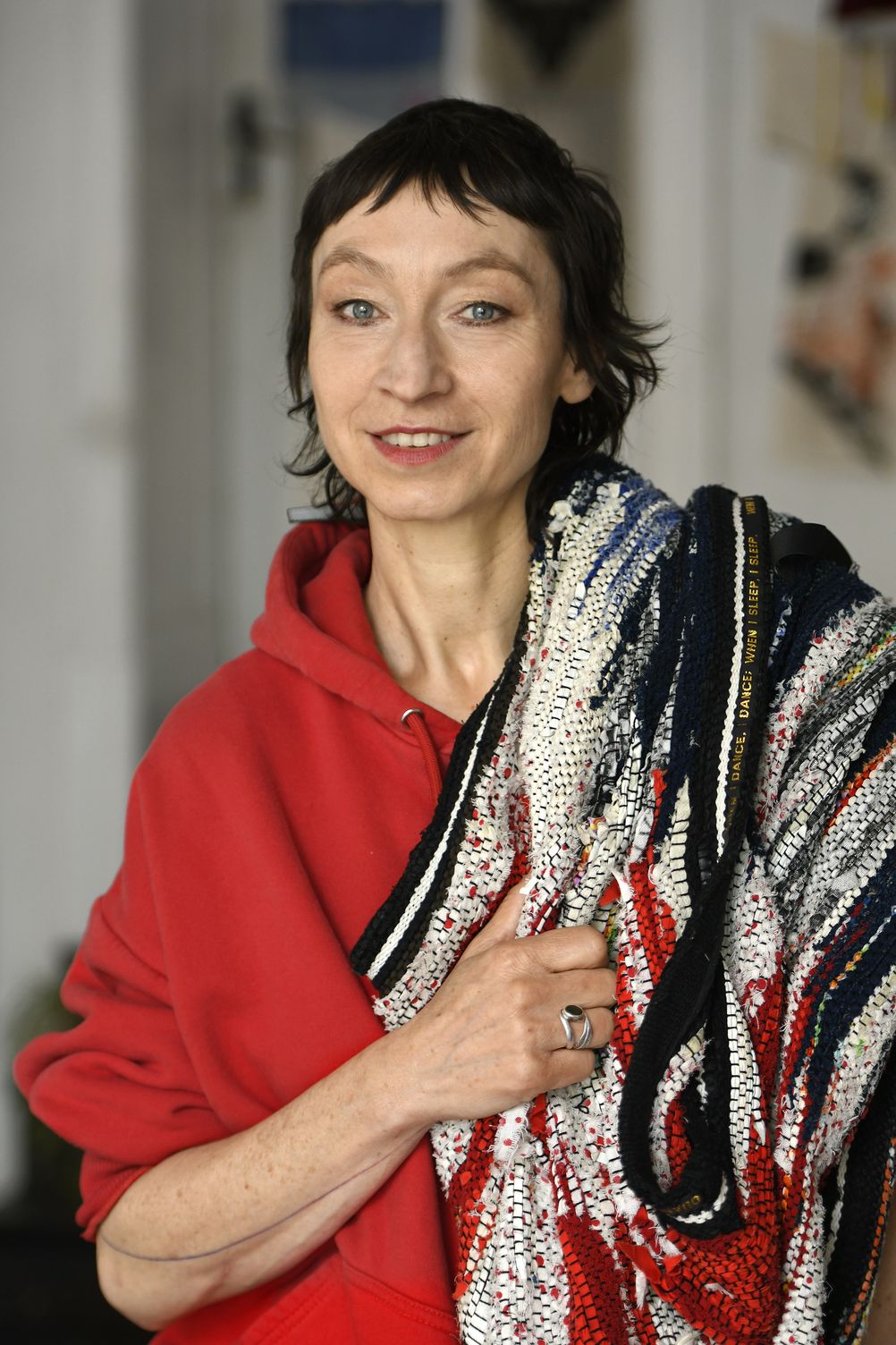
Claudia Hill is a cross-disciplinary, textile-based artist living in Berlin. Her exhibitions and scenarios in which people and textiles come together are presented internationally in the context of visual and performance art, in venues such as Paris Internationale, mumok, Hofstallung - Museum moderner Kunst Stiftung Ludwig Wien, Shedhalle, Zurich, and HAU Hebbel am Ufer, Berlin. Her costume designs include collaborations with The Wooster Group and numerous choreographers such as William Forsythe and Meg Stuart. Drawing on a deeply rooted relationship with textiles that began in the world of fashion, she explores ways of communication through multi-sensory experiences and the transformative potential of textile objects. Her publication Social Fabric Earth Return, released on the occasion of her exhibition at Efremidis gallery during Berlin Art Week by Bom Dia Boa Tarde, is the prelude to long-term research around weaving. She invites fellow artists to gather around an ancient tapestry loom, which she understands as a social sculpture, creating a space where life and art meet.
Installations & Performances
| 2023 | Gedanken Spielen Verstecken – Installation, Haus Kunst Mitte, Berlin, DE |
| 2022 | Protozone7 – exhibition with performances, Shedhalle, Zurich, CH |
| Weaving Roots – exhibition with performances, Bärenzwinger, Berlin, DE | |
| 2021 | Social Fabric Earth Return – solo exhibition, Efremidis, Berlin, DE |
| Social Fabric Earth Return – publication, Bom Dia Boa Tarde Boa Noite, Berlin | |
| 2020 | – installation, Internationales Sommerfestival, Kampnagel, Hamburg, DE |
| Unacknowledged Loss II – performance lecture, HAU Hebbel am Ufer, Berlin, DE | |
| 2019 | Paris Internationale – Performance, Aaahhh!!! Paris Internationale, Paris, FR |
| Fragility Organizes Community – performances and installation ImPulsTanz, Mumok, Wien, AT | |
| Flag for Healing – Installation, Dance Congress, European Center for the Arts, Hellerau, DE | |
| 2018 | Supernova – performances and installation, HAU Hebbel am Ufer, Berlin, DE |
| 2017 | Flag From Tomorrow – installation, Maus Habitos, Porto, PT |
| Unacknowledged Loss / Softcore – performance, HAU Hebbel am Ufer, Berlin, DE | |
| Kŏn′voi′ – short film, Rencontres Intl. Paris and HKW, Berlin; HAU Hebbel am Ufer, Berlin; Videoskin, Kathmandu, Nepal; FIVC, Santiago; Vo ́Arte, Lisbon; London Eye Intl. Film Festival; Fragment Gallery, Moscow; Athens Video Dance Project; Solaris Film Festival, Nice; Arte Non Stop Festival, Buenos Aires; Bienal Intl. de Danza de Cali, Colombia; Formosa Festival of Intl. Filmmaker Awards, Taiwan | |
| Katapult – performance, Live Arts Week VI, Ex GAM, Bologna, IT | |
| 2016 | Triangles – Ephemeral Sculptures, Lab ABC, Arbecey, FR |
| 2013-2014 | Collective Stitching – gatherings for Noa Eshkol Foundation, Neugerriemschneider, Berlin, DE |
| 2013 | Tape Graffiti – with Damaged Goods Productions, Centre Pompidou, Paris, FR |
| 2012 | Blanket Lady – installation and performance with Meg Stuart, ZKM Karlsruhe, DE |
| 2005 | Wasserwünsche – installation and performance with Nelly Agassi, Art Forum Berlin, DE |
| 2002 | ~ISM – installation, The Lincoln Modern, Singapore, SG |
| 1999 | Color Lab – installation and performance, DUMBO Arts Center, New York City, US |
Costumes & Scenography
| 2022 | Körper Deluxe – performance by Josep Caballero Garcia, Kampnagel, Hamburg, DE |
| Trajectories for a Landscape – video lab with Meg Stuart, Abraham Hurtado, Zero Point, HAU, Berlin, DE | |
| 2021 | Who’s Afraid of Raimunda – film by Josep Garcia Caballero, HAU Hebbel am Ufer, Berlin, DE |
| 2020 | Who’s Afraid of Raimunda – performance by Josep Garcia Caballero, Kampnagel, Hamburg, DE |
| Ding Dong – performance by Lucie Tuma, Gessnerallee, Zurich, CH | |
| Water Sports – performance by Karol Tyminski, Ufer Studios Berlin, DE | |
| 2019 | Eye Sea – performance by Anna Nowicka, HAU Hebbel am Ufer, Berlin, DE |
| Wismut – performance by Jule Flierl & Mars Dietz, Schauspiel Leipzig, Sophiensäle Berlin, DE | |
| Slow Dance – performance by Louise Dahl & Hana Lee Erdman, MDT, Stockholm, SE | |
| The Clearing – performance by Jeremy Wade, HAU Hebbel am Ufer, Berlin, DE | |
| The Nature of Us – performance by Angela Schubot & Jared Gradinger, HAU Hebbel am Ufer, Berlin, DE | |
| 2018 | JLP 2043 – performance by Lucie Tuma, Gessnerallee, Zurich, CH |
| YEW – performance by Jared Gradinger and Angela Schubot, HAU Hebbel am Ufer/ Botanical Gardens Pankow, DE | |
| YEW – performance by Jared Gradinger and Angela Schubot, HAU Hebbel am Ufer, Berlin, DE | |
| 2017 | Pharmacist or Balloonist – choreographic herbal laboratory by Elpida Orfanidou & Guests, Ballhaus Ost, Onassis Cultural Centre Athens |
| The Battlefield Nurse – performance by Jeremy Wade, Gessnerallee, Zurich, CH; HAU, Hebbel am Ufer, Berlin e.a | |
| 2016 | Tanz im August – poster campaign, International Festival Berlin, DE |
| On The Rocks – performance by Lucie Tuma, Gessnerallee, Zurich, CH | |
| 7 Dialogs – performances by Dance On Ensemble, Holland Dance Festival, Den Haag; HAU, Berlin; Theater im Pfalzbau, Ludwigshafen, DE; San Sebastian, ES; Schauspiel Frankfurt, DE e.a. | |
| 2015 | Korinna und Jörg – performance by Laurie Young, Sophiensäle, Berlin,DE |
| 2014 | Hunter – performance by Meg Stuart at HAU Hebbel am Ufer, Berlin, DE; La Biennale di Venezia, Venice, IT; Centre Pompidou, Paris, FR; Kaaitheater, Brussels, BE; deSingel, Antwerp, BE; Münchner Kammerspiele, DE; Gessnerallee, Zurich, CH; La Bâtie Festival, Geneva, CH; PACT Zollverein, Essen, DE; Usine C, Montreal, CAN; REDCAT, Los Angeles, US; Tanzquartier Wien, Vienna, AT e.a. |
| 2013 | Sketches/Notebook – performance by Meg Stuart, HAU Hebbel am Ufer, Berlin, DE; Centre Pompidou, Paris, FR; Ashkal Alwan, Beirut, LB; Münchner Kammerspiele, DE; Kunstencentrum Vooruit, Ghent, BE; Kaaitheater, Brussels, BE; MuseumsQuartier, Vienna, AT; Gessnerallee, Zurich, CH; Holland Festival, Amsterdam, NL; PACT Zollverein, Essen |
| 2012 | Untitled Film – artist film by Michaël Borremans and Meg Stuart |
| Séances – artist film by Boris Achour. La Triennale, Paris | |
| 2011 | Cut & Mend – film with Meg Stuart, film festivals in Los Angeles, Hong Kong, Amsterdam, Burgundy e.a. |
| 2010 | Look, Stranger – film by Arielle Javitch, Toronto International Film Festival, CAN |
| 2007 | Hamlet - performance by The Wooster Group, The Public Theater, New York, US; São Paulo, Edinburgh, Amsterdam, Berlin, Los Angeles, Barcelona, Santiago e.a. |
| 2006 | Fischerspooner – live concert, Florence Opera, IT |
| 2004 | Poor Theater – The Wooster Group. Performed in New York, Los Angeles, Brussels, Berlin, Warsaw e.a. |
| 2003 | Decreation – William Forsythe, Ballet Frankfurt. Performed in Frankfurt, New York, Paris, London, Zurich, Amsterdam, Berlin e.a. |
| 1996-1998 | Numerous theatre and film productions, among others All my Sons with Arthur Miller at the Roundabout Theatre, Broadway, NYC. |
| 1995-1997 | Rent – Co-design for original production, Broadway and U.S. tour 1997 |
Clothing Archive
| 1998-2011 | Own fashion label, with presentations, performances and installations during New York Fashion Week, Tokyo, Paris, Berlin, Tel Aviv, Brussels |
| Exclusive contract with Japanese distributor Mitsubishi Rayon, Tokyo (Marc Jacobs, Christophe Lemaire e.a.) and Official Member of German ASEM delegation, representing German design at ASEM 5, own store in Berlin |
Grants
| 2023 | Dachverband Tanz Deutschland – Dis-Tanz-Solo, Berlin, DE |
| 2022 | Fonds Darstellende Künste – Take Heart, Berlin, DE |
| 2021 | Berlin Senate for Culture and Europe – Research Grant, Berlin, DE |
| National Performance Network – Stepping Out, Munich, DE | |
| Fonds Darstellende Künste – Take Care, Berlin, DE | |
| 2020 | Gwaertler Stiftung – Basel, CH |