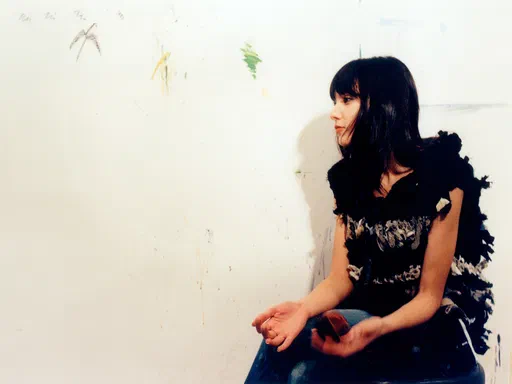
“I’m not good with words”, says Claudia Hill, when we meet at her Brooklyn studio, “so I could never describe all the feelings I express through my designs. But what I can do is work as a kind of emotional architect who captures expression in clothing, so that they can function as a portable diary for the people who wear them. After all, I am sculpting clothing as a house for the body. To me, a textile’s surface, with all its subtle details, resembles the inside, the internal.”
Flowing freely between self-expression and art-like objects comes easily to Hill, who trained to be a dancer. She left her native Germany to continue her dance studies in New York, where she discovered that she also had a talent for costume design. A chance meeting with Spanish designer Miguel Adrover resulted in a commission for some pieces that he sold in his shop, Horn, in New York. “I was in this beautiful flow from dance to design,” Hill remembers, “and one moment I was making my own clothes, the next I was making them for Miguel’s shop, and suddenly I was also making them for some clients in Japan.”
Hill eschews traditional catwalk shows and presents her collections through performances, installations and presentations held at her boutique in Berlin. “I never considered adapting to the traditional fashion formats,” Hill says, “because my work is about the one-off and not things that can be mass-produced. I really enjoy designing the textiles I use, whether they are new fabrics or found materials. Structuring my textiles enables me to be playful, experimental and find a way to break boundaries. That would never be possible with conventional fabrics.”
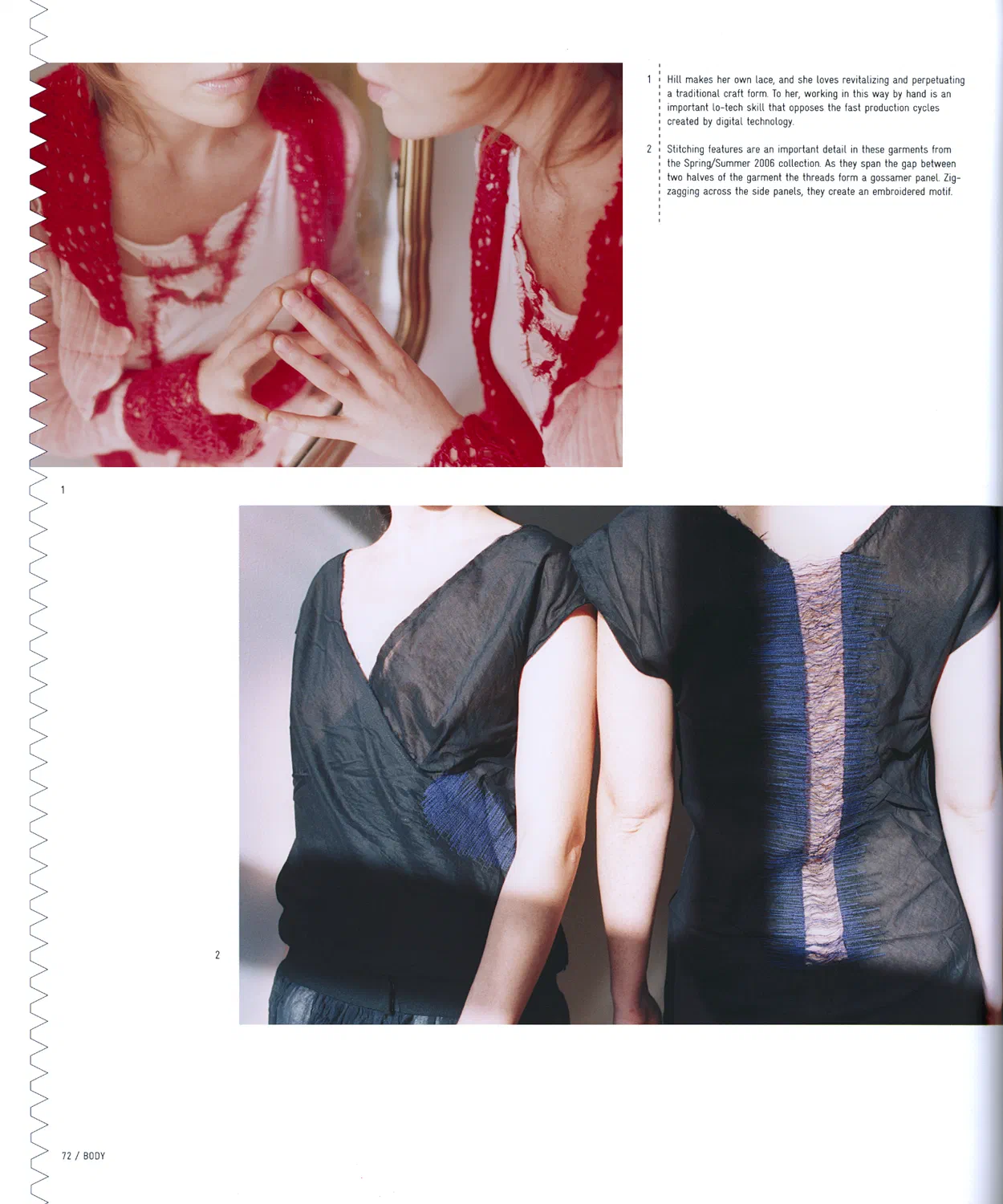
Some of Hill’s fabrics are scented with herbs to add an intangible experience to the garment. Others are weighted with stones sewn into tiny pouches created by touching the fabric, enabling it to hang in a certain way or acquire a unique texture. Hill has even made her own lace, regarding the open structure of the lace to be the antithesis of the closed surface surrounding the stones. “Lacemaking is an ancient craft.” Hill says, “and making lace by hand today is the opposite of all the fast production cycles created by technology.”
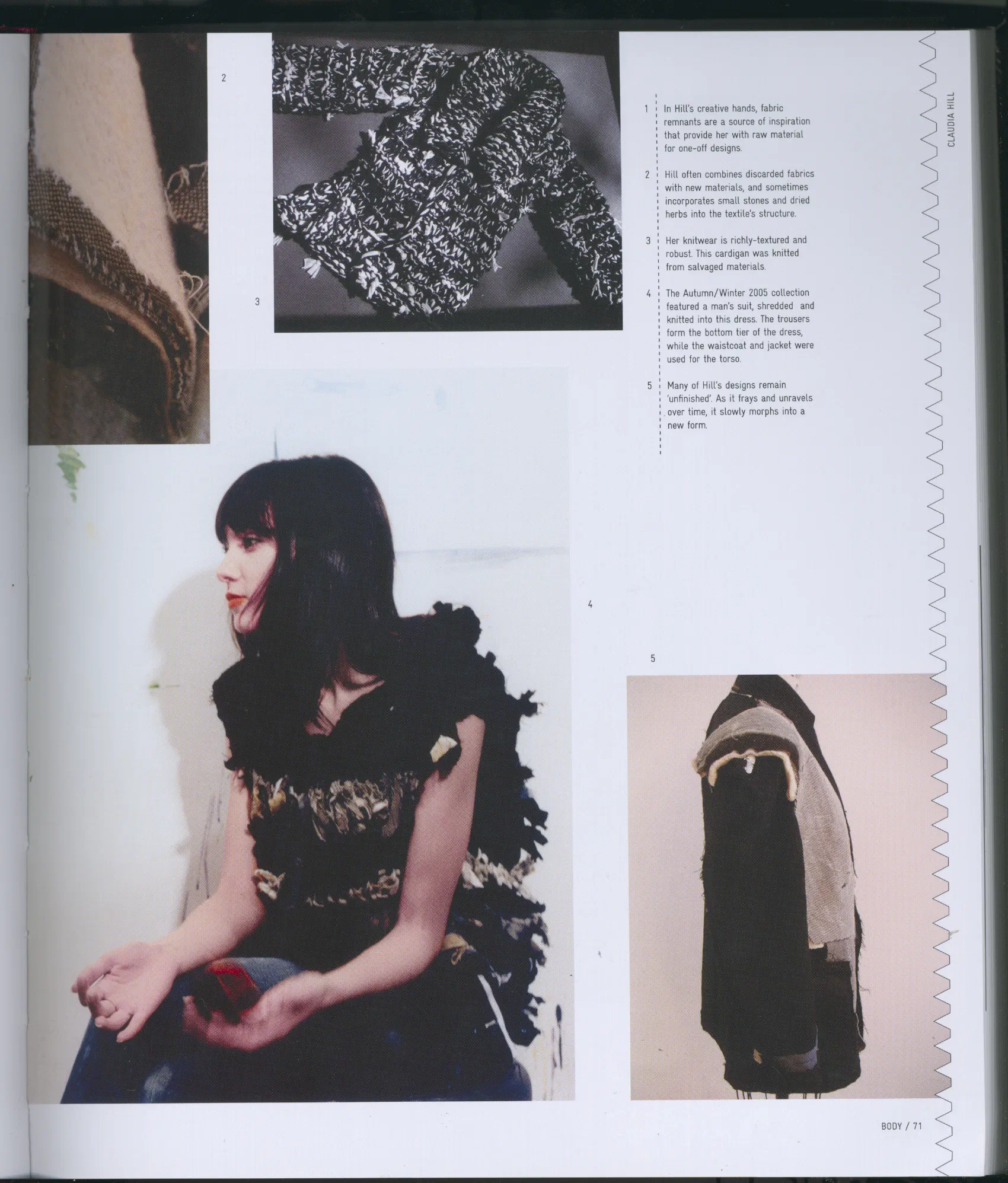
Hill once famously shredded a man’s suit, then knitted it into a cocktail dress. “I loved the process of taking a man’s garment and transforming it into something beautiful for
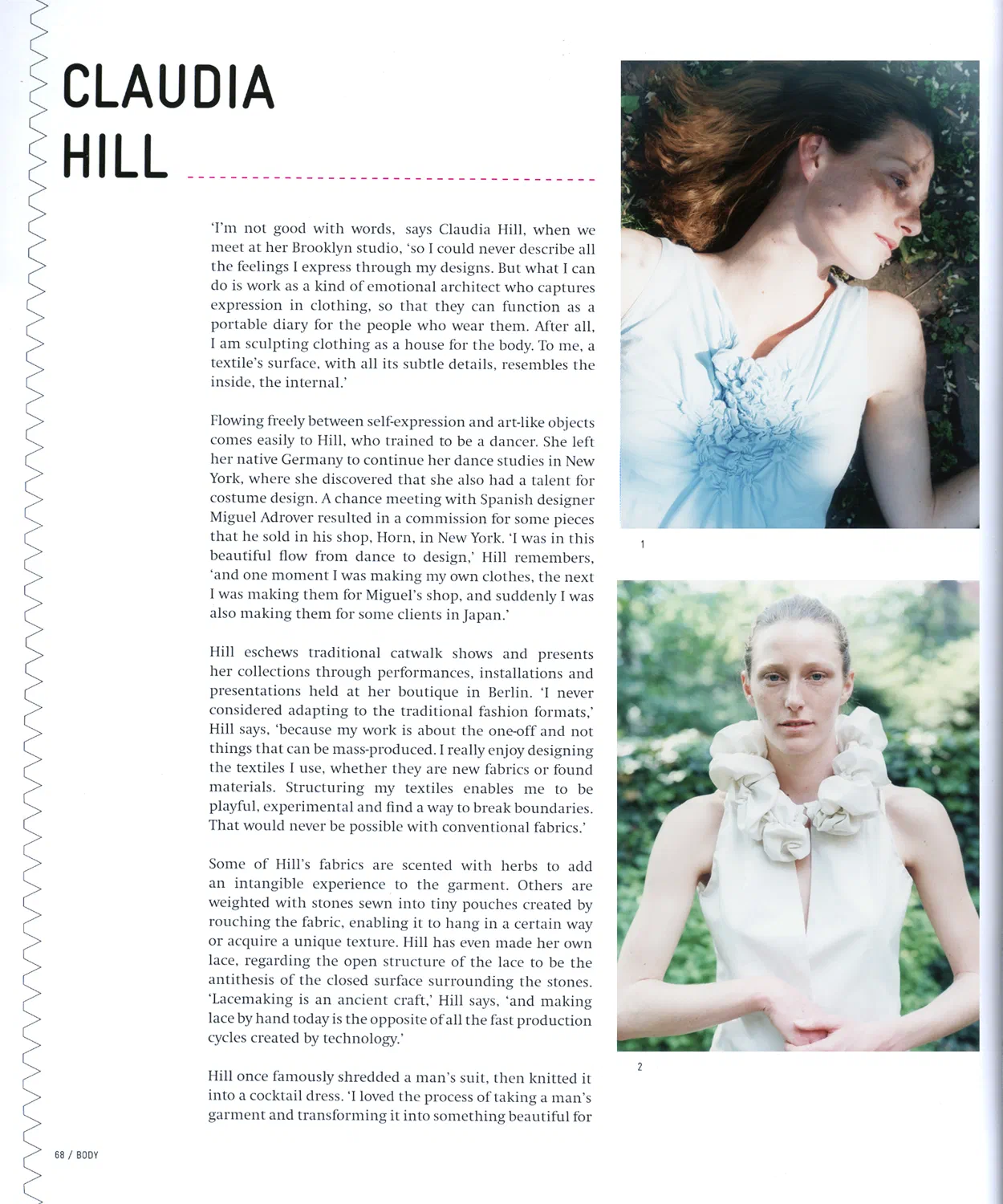
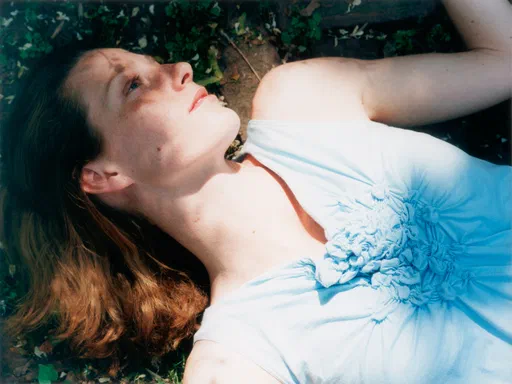
1-2: To Claudia Hill, a garment’s surface is a metaphor for feelings, thoughts and sentiments. She structures and sculpts her fabrics to make each garment a unique piece. Soft folds can create corsage-like detailing (1), while a collar (2) gives a garment a strong silhouette.
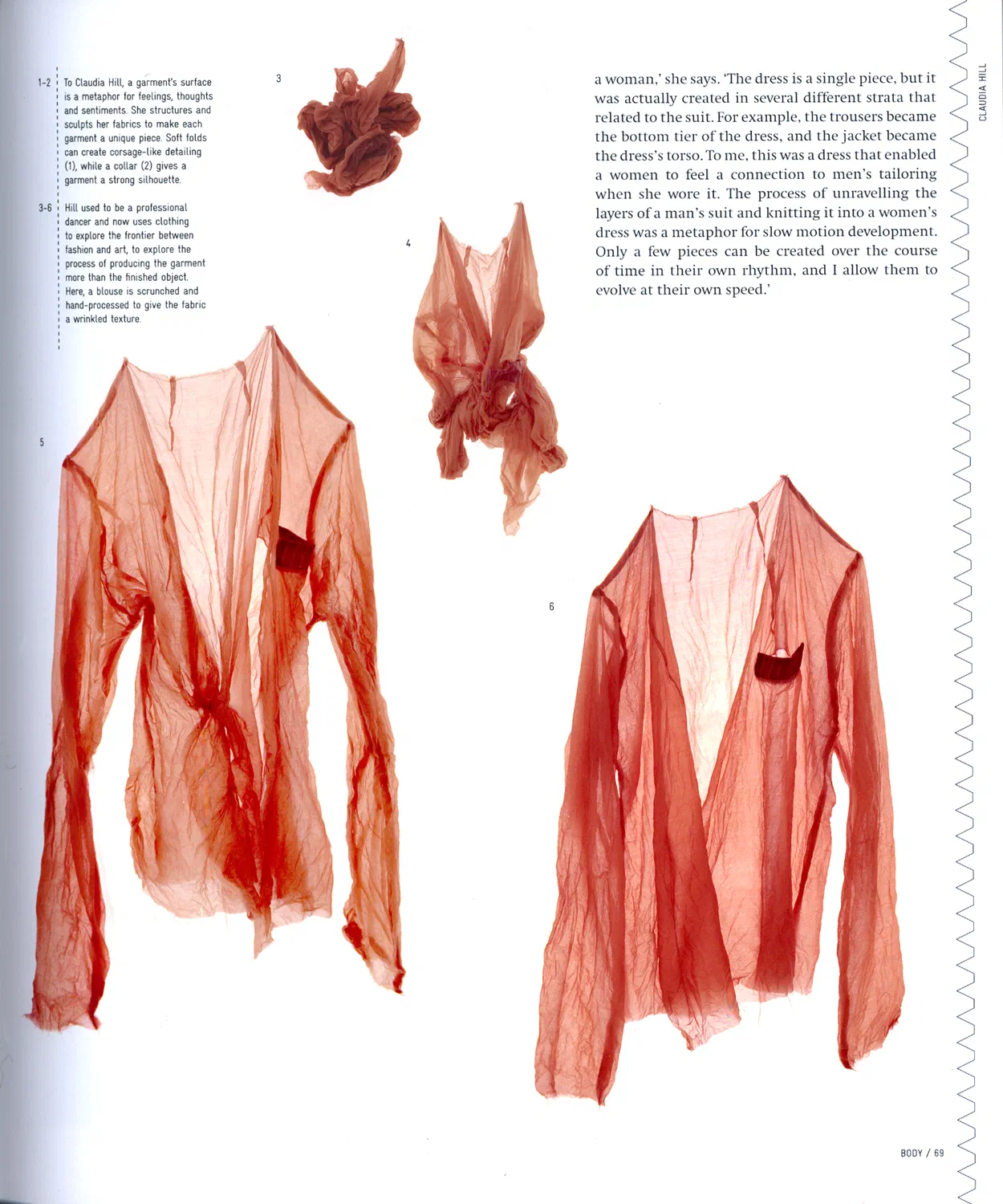
3-6: Hill used to be a professional dancer and now uses clothing to explore the frontier between fashion and art, to explore the process of producing the garment more than the finished object. Here, a blouse is scrunched and hand-processed to give the fabric a wrinkled texture.
a woman,” she says. “The dress is a single piece, but it was actually created in several different strata that related to the suit. For example, the trousers became the bottom tier of the dress, and the jacket became the dress’s torso. To me, this was a dress that enabled a woman to feel a connection to men’s tailoring when she wore it. The process of unraveling the layers of a man’s suit and knitting it into a women’s dress was a metaphor for slow motion development. Only a few pieces can be created over the course of time in their own rhythm, and I allow them to evolve at their own speed.”
A page from the book Textile Designers at the Cutting Edge, in its chapter profiling Claudia Hill. The photograph shows a heap of rolled, labeled fabric remnants, captioned elsewhere in the profile as the raw material Hill draws on for her one-off designs.
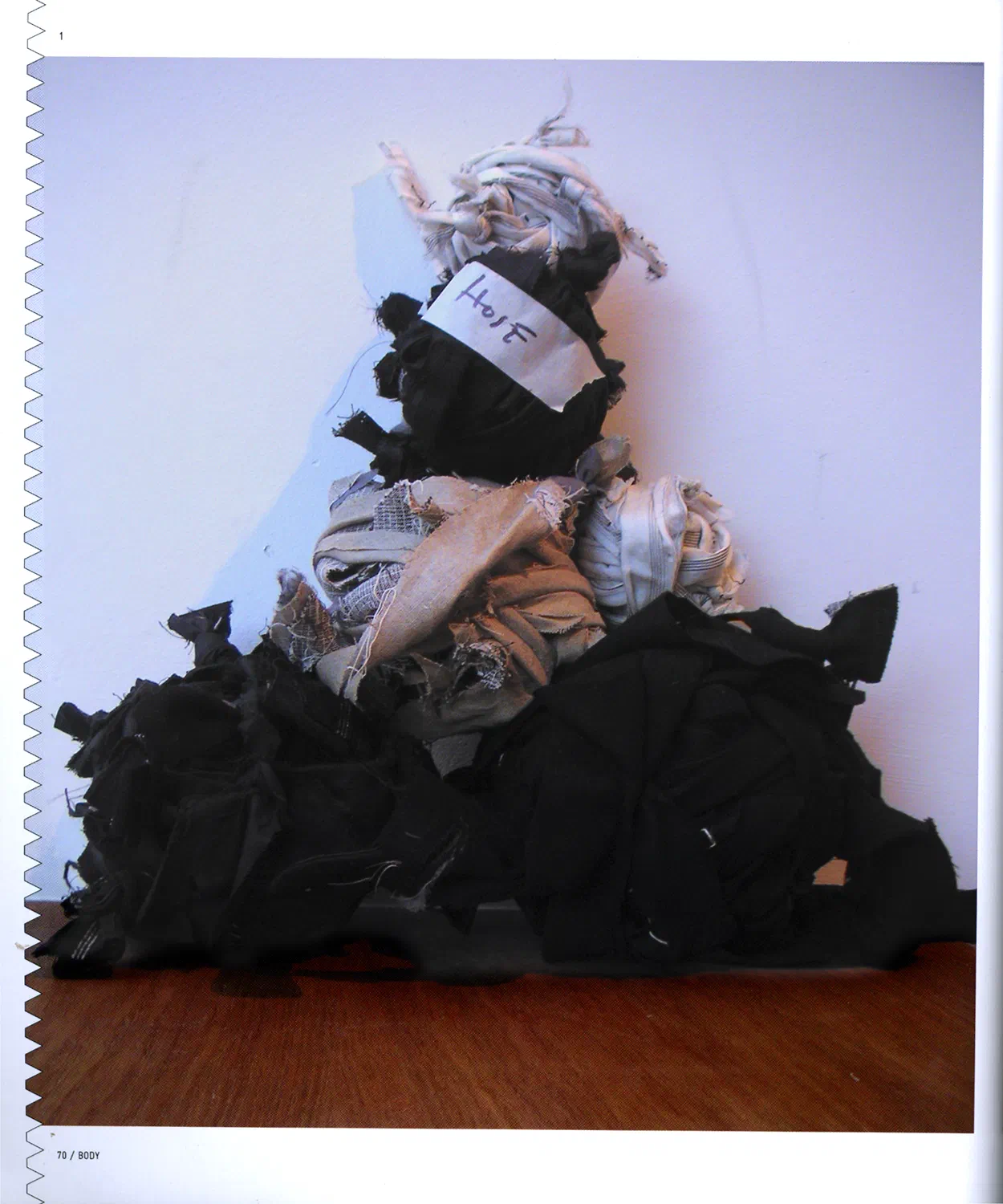
1 In Hill’s creative hands, fabric remnants are a source of inspiration that provide her with raw material for one-off designs
2 Hill often combines discarded fabrics with new materials, and sometimes incorporates small stones and dried herbs into the textile’s structure.
3 Her knitwear is richly-textured and robust. This cardigan was knitted from salvaged materials
4 The Autumn/Winter 2005 collection featured a man’s suit, shredded and knitted into this dress. The trousers form the bottom tier of the dress, while the waistcoat and jacket were used for the torso.
5 Many of Hill’s designs remain “unfinished” As it frays and unravels over time, it slowly morphs into a new form.
Another page from the same profile, pairing two photographs with short captions. One describes Hill making her own lace by hand as a deliberate, lo-tech counter to fast digital production; the other explains zigzag stitching on a Spring/Summer 2006 garment, where threads bridge two panels into an embroidered seam.
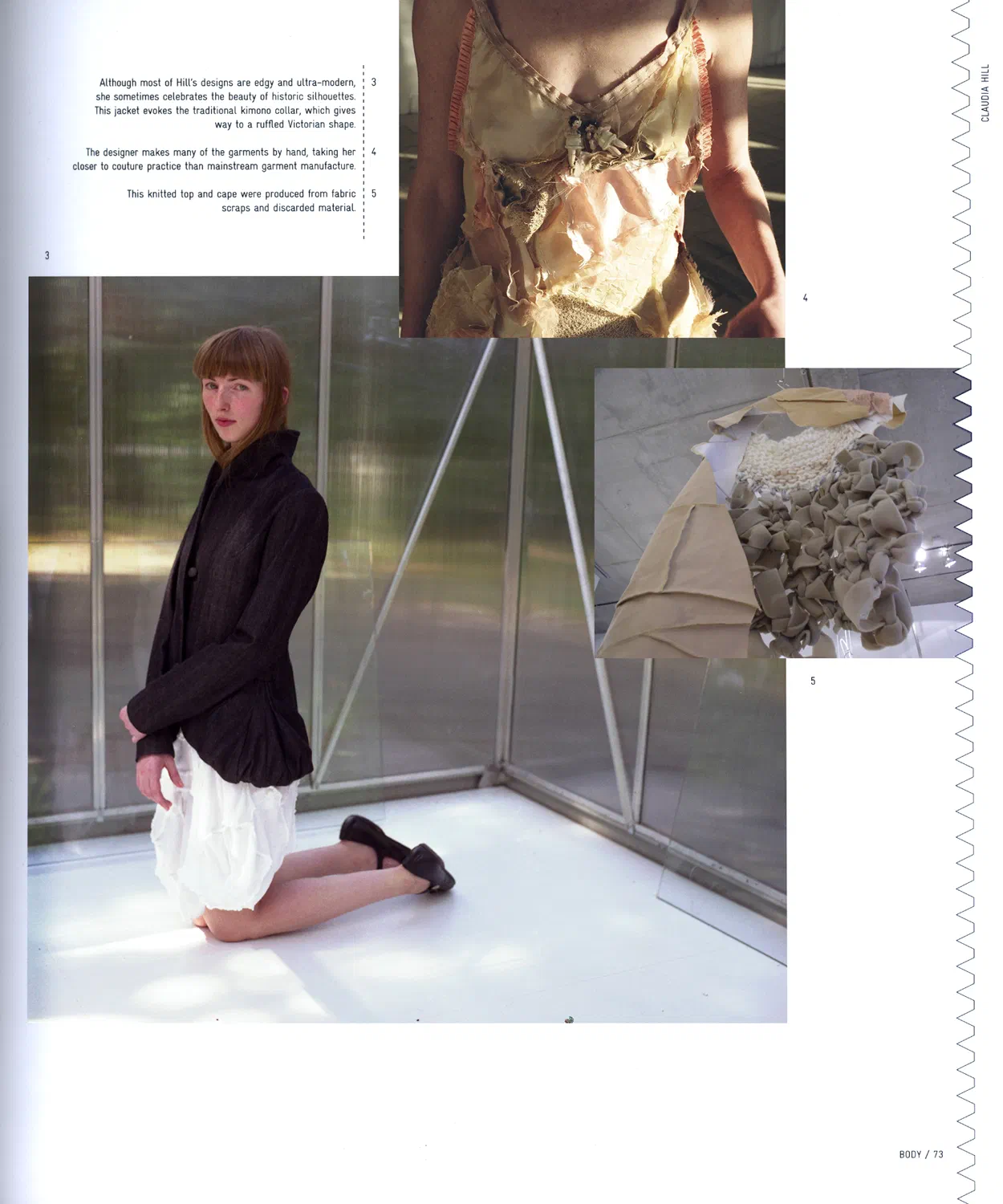
The closing page of the profile, with three more captioned photographs. They describe a jacket moving from a kimono collar into a ruffled Victorian silhouette, note that Hill makes many garments by hand in a near-couture process, and identify a knitted top and cape made from fabric scraps and discarded material.