
Cover photo of Books: William Forsythe

William Forsythe

Denken in Bewegung

by Gerald Siegmund

Henschel Verlag, 2004
ISBN 978-3894874728

114 Dana Caspersen

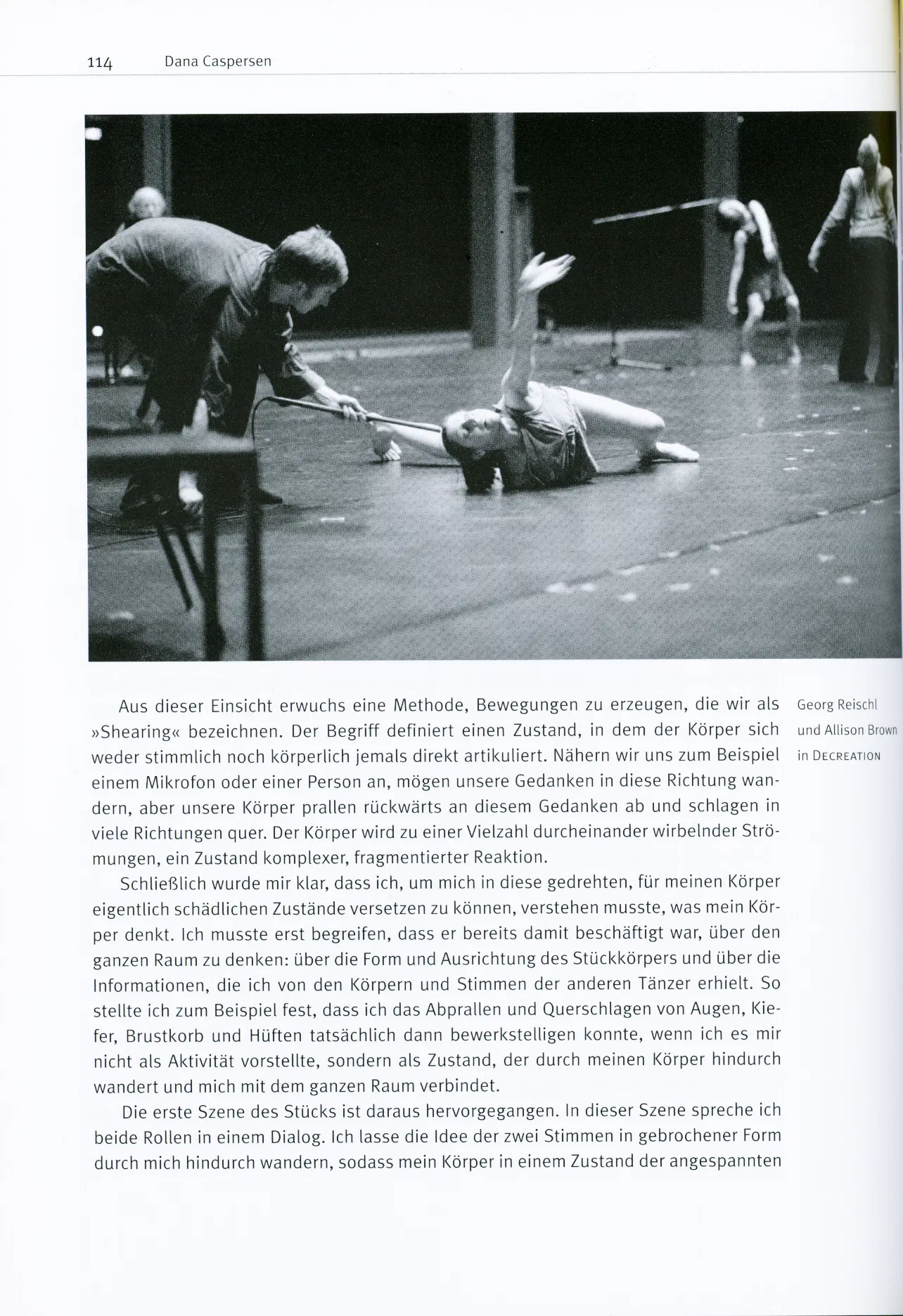
Out of this insight grew a method of generating movement that we call “Shearing”. The term defines a state in which the body never articulates itself directly, either vocally or physically. If we approach a microphone or a person, for example, our thoughts may travel in that direction, but our bodies rebound backwards off that thought and cut across in many directions. The body becomes a multitude of currents swirling into one another, a state of complex, fragmented reaction.

In the end I realized that in order to put myself into these twisted states, which are in fact harmful to my body, I had to understand what my body thinks. First I had to grasp that it was already busy thinking about the whole space: about the shape and orientation of the body of the piece, and about the information I was receiving from the bodies and voices of the other dancers. I found, for example, that I could actually bring about the rebounding and cutting across of eyes, jaw, ribcage and hips when I imagined it not as an activity but as a state that travels through my body and connects me with the whole space.

The first scene of the piece came out of that. In this scene I speak both roles in a dialogue. I let the idea of the two voices travel through me in broken form, so that my body is in a state of tense

Georg Reischl and Allison Brown in Decreation

Translated from the original by machine.

114 Dana Caspersen

Aus dieser Einsicht erwuchs eine Methode, Bewegungen zu erzeugen, die wir als »Shearing« bezeichnen. Der Begriff definiert einen Zustand, in dem der Körper sich weder stimmlich noch körperlich jemals direkt artikuliert. Nähern wir uns zum Beispiel einem Mikrofon oder einer Person an, mögen unsere Gedanken in diese Richtung wandern, aber unsere Körper prallen rückwärts an diesem Gedanken ab und schlagen in viele Richtungen quer. Der Körper wird zu einer Vielzahl durcheinander wirbelnder Strömungen, ein Zustand komplexer, fragmentierter Reaktion.

Schließlich wurde mir klar, dass ich, um mich in diese gedrehten, für meinen Körper eigentlich schädlichen Zustände versetzen zu können, verstehen musste, was mein Körper denkt. Ich musste erst begreifen, dass er bereits damit beschäftigt war, über den ganzen Raum zu denken: über die Form und Ausrichtung des Stückkörpers und über die Informationen, die ich von den Körpern und Stimmen der anderen Tänzer erhielt. So stellte ich zum Beispiel fest, dass ich das Abprallen und Querschlagen von Augen, Kiefer, Brustkorb und Hüften tatsächlich dann bewerkstelligen konnte, wenn ich es mir nicht als Aktivität vorstellte, sondern als Zustand, der durch meinen Körper hindurch wandert und mich mit dem ganzen Raum verbindet.

Die erste Szene des Stücks ist daraus hervorgegangen. In dieser Szene spreche ich beide Rollen in einem Dialog. Ich lasse die Idee der zwei Stimmen in gebrochener Form durch mich hindurch wandern, sodass mein Körper in einem Zustand der angespannten

Georg Reischl und Allison Brown in Decreation
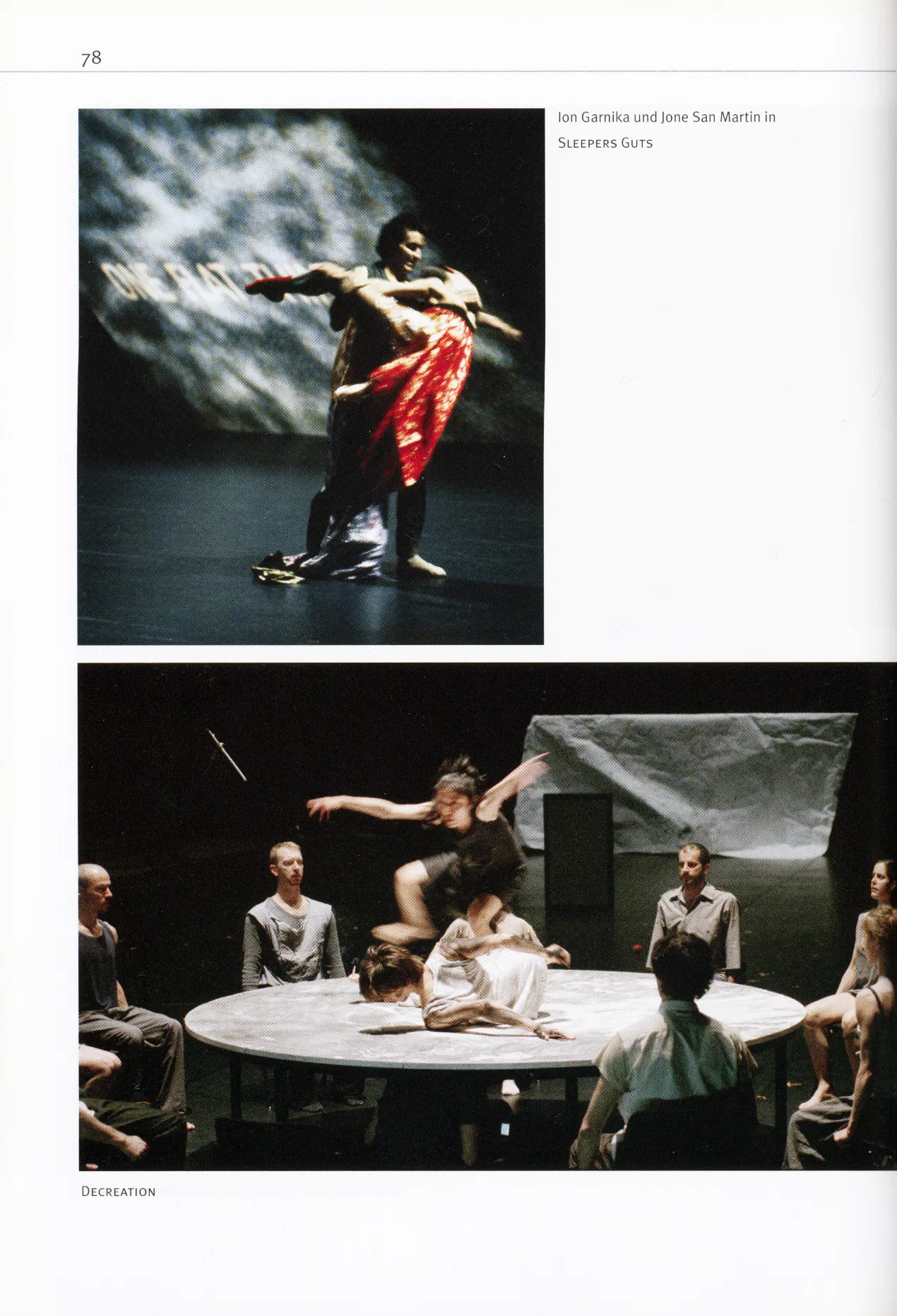
Ion Garnika and Jone San Martin in

SLEEPERS GUTS

Translated from the original by machine.

Ion Garnika und Jone San Martin in

SLEEPERS GUTS