les presses du réel, 2024
ISBN 9782960320718
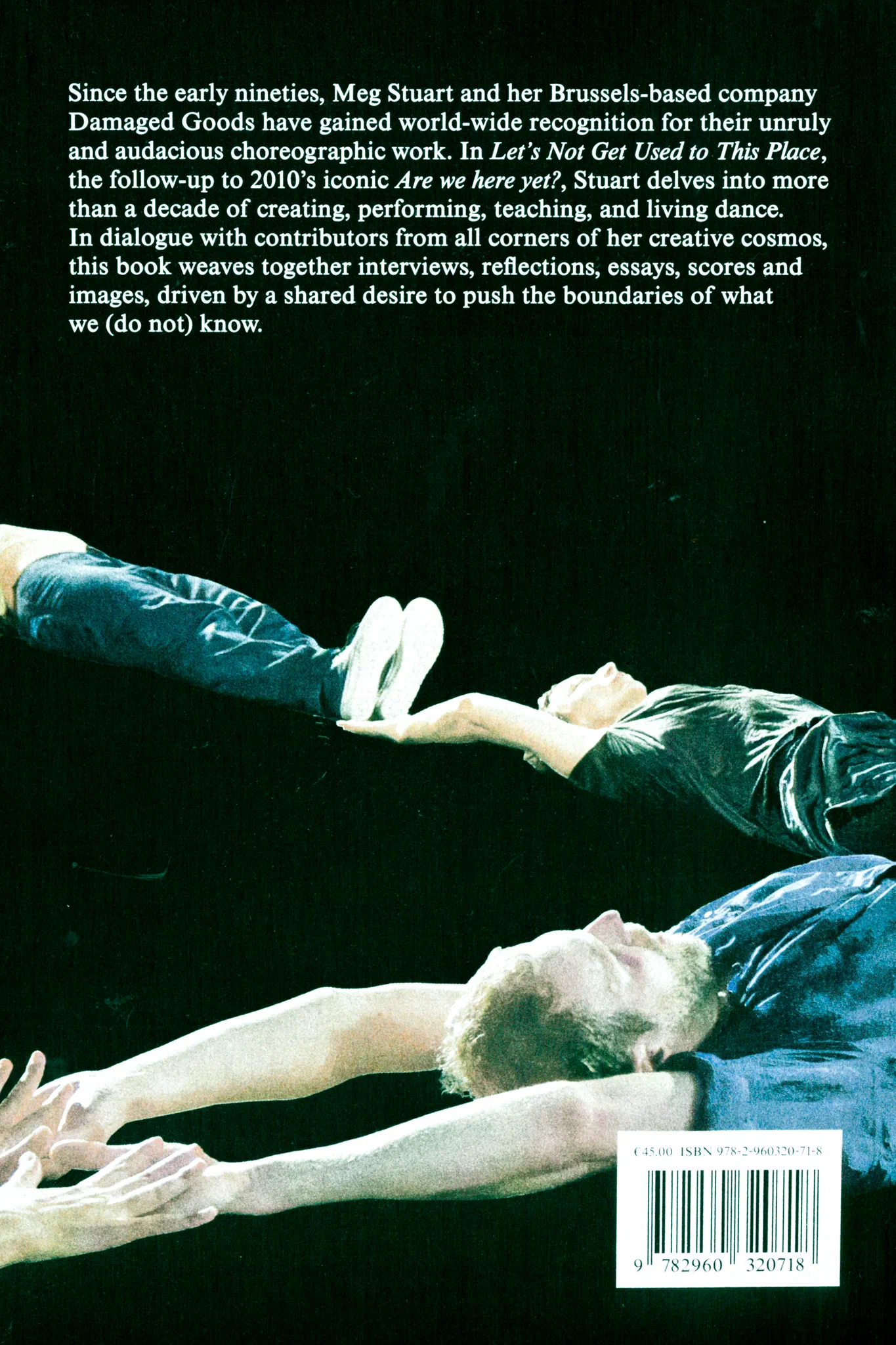
The back cover of Let's Not Get Used to This Place, a book about choreographer Meg Stuart and her company Damaged Goods, gathering interviews, essays, scores, and images from more than a decade of the company's work as a follow-up to the 2010 book Are We Here Yet? Below the synopsis, a color photograph shows two dancers in a floor-level lift, one bracing feet and hands against the other's raised legs.
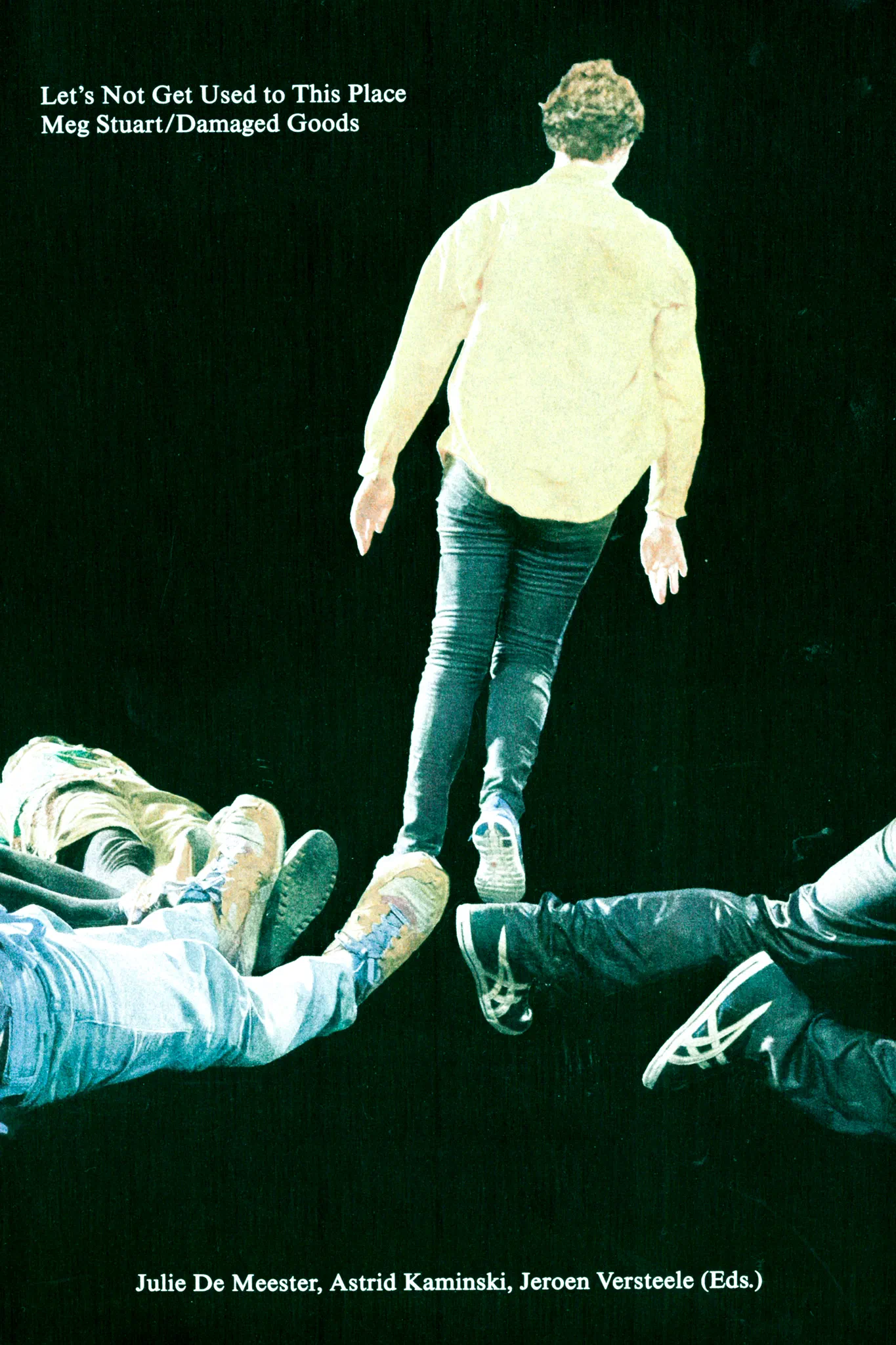
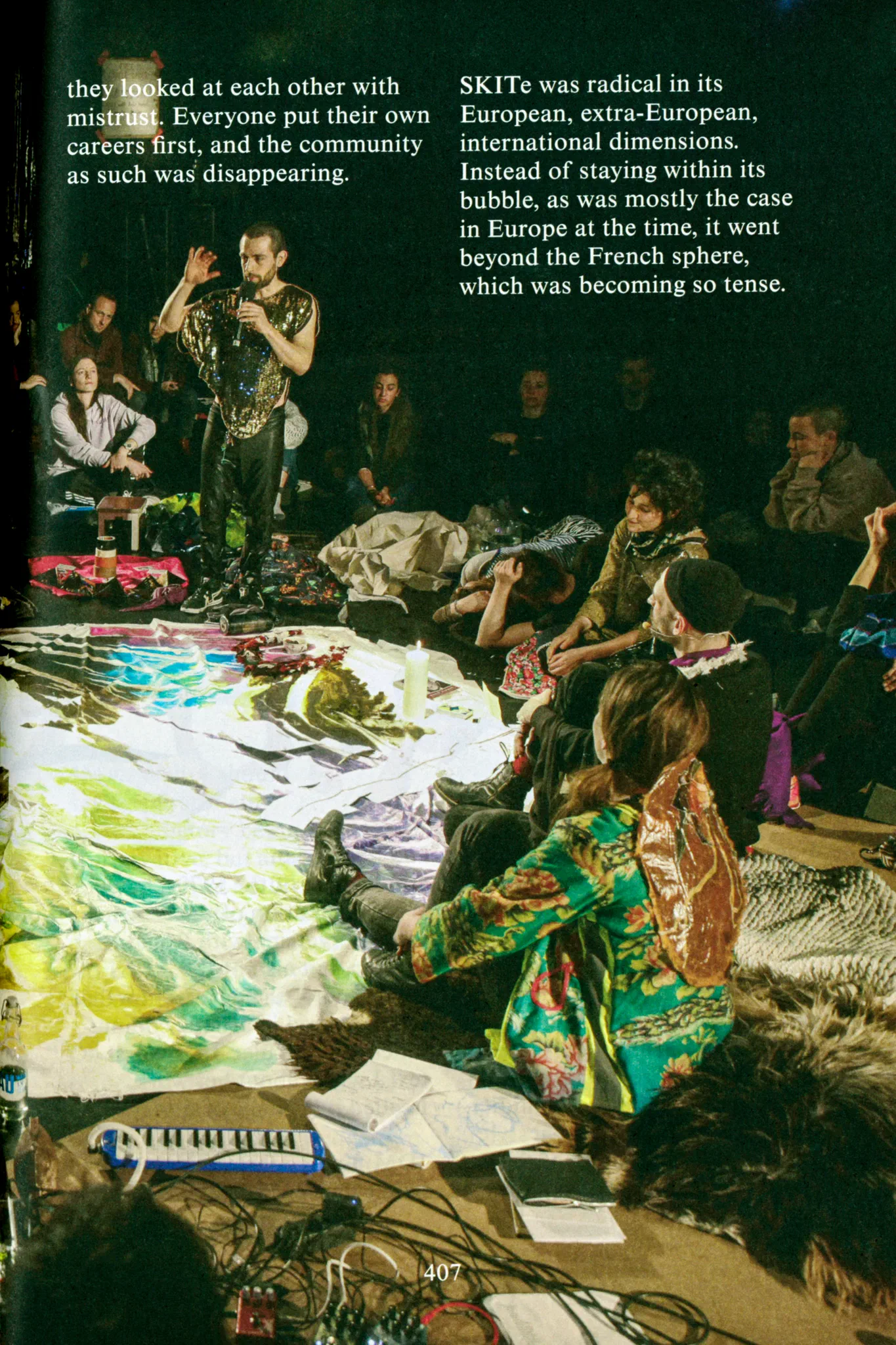
The front cover of the same book, giving its title, its credit to Meg Stuart/Damaged Goods, and its editors: Julie De Meester, Astrid Kaminski, and Jeroen Versteele. The cover photograph shows a figure walking upstage in the dark, one foot planted between the splayed legs of two dancers sprawled on the floor at either side.
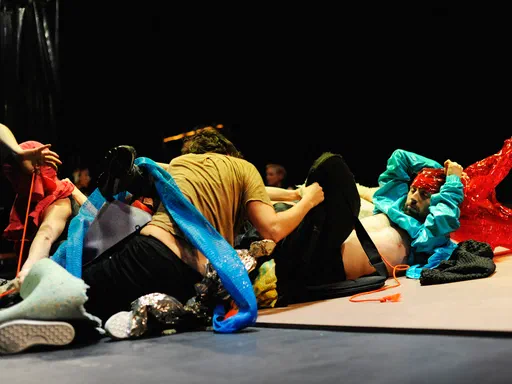
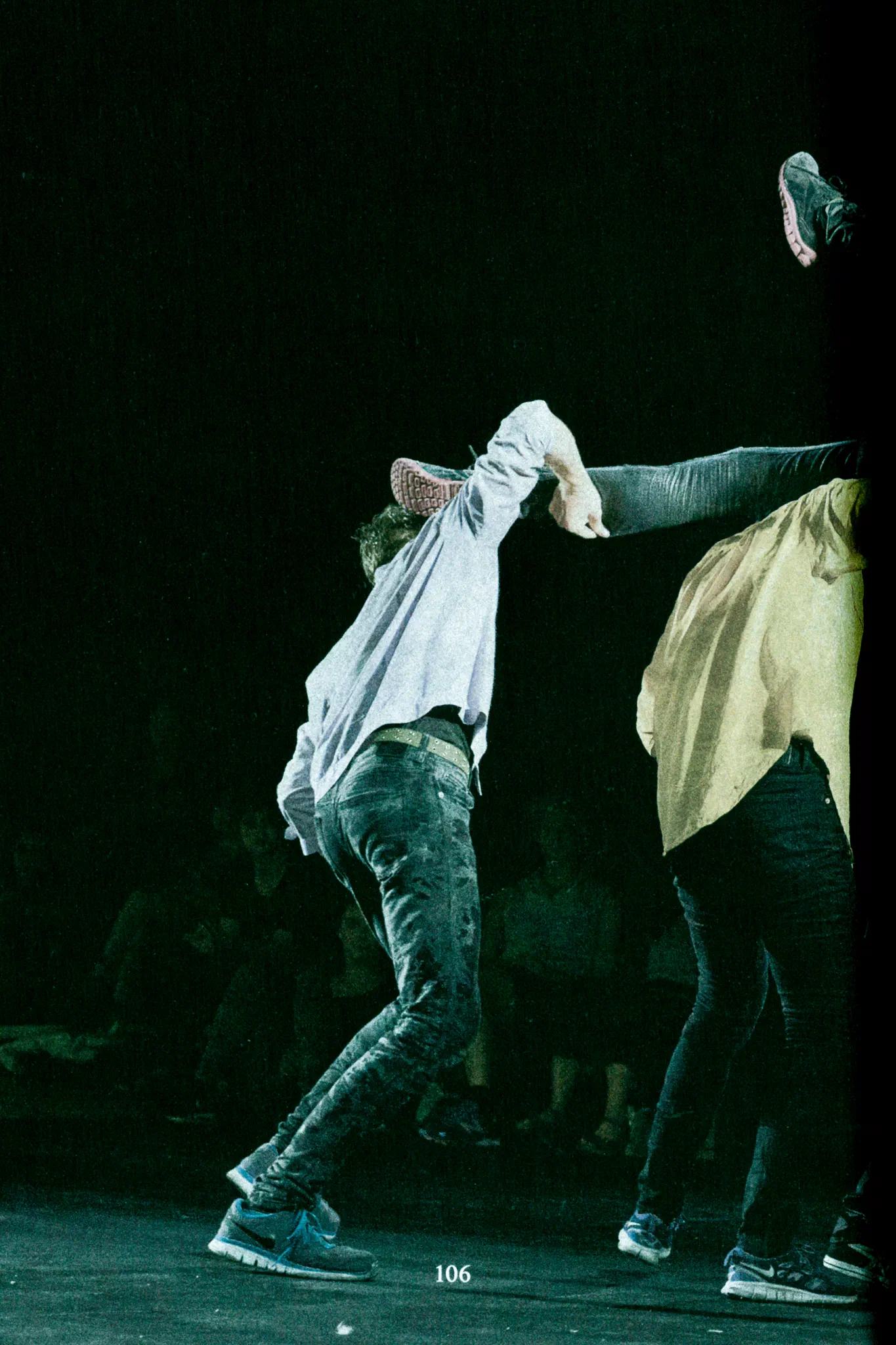
A full-page performance photograph opening the book's account of the piece Sketches/Notebook, a few pages ahead of Meg Stuart's own description of it. It catches two dancers in mid-motion on stage during the loosely structured, collaborative event, uncaptioned beyond its page number.
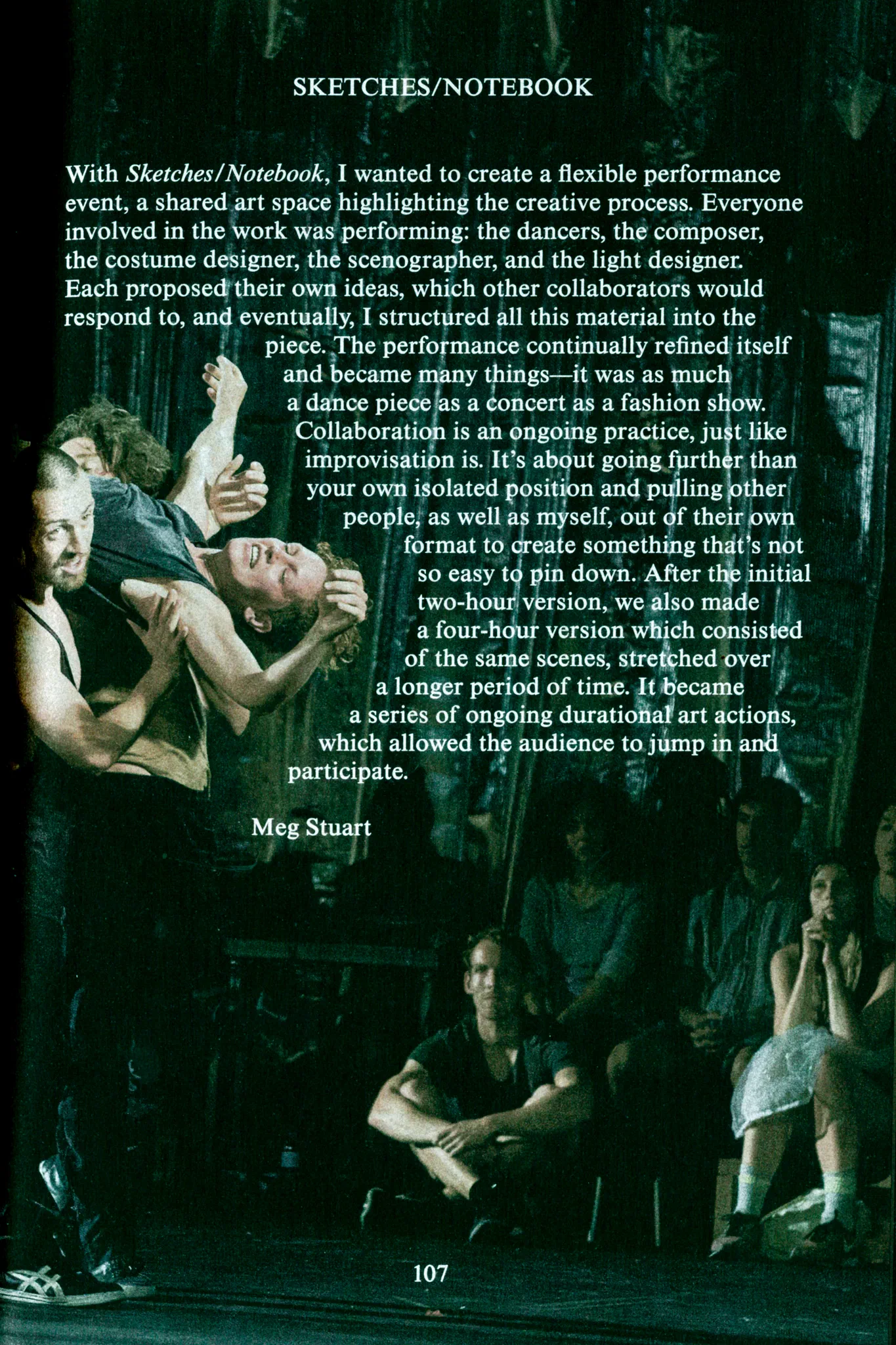
A text page opening the Sketches/Notebook section with a statement by Meg Stuart, describing the piece as a flexible, shared performance event in which dancers, composer, costume designer, scenographer, and light designer all performed and responded to one another's proposals. She calls the result as much a dance piece as a concert or a fashion show, later stretched into a four-hour version the audience could join. A small photograph shows dancers lifting and embracing before a seated audience.
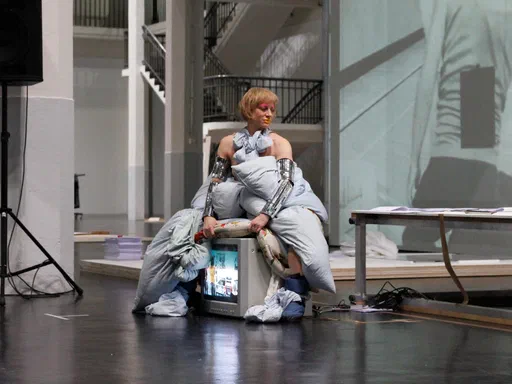
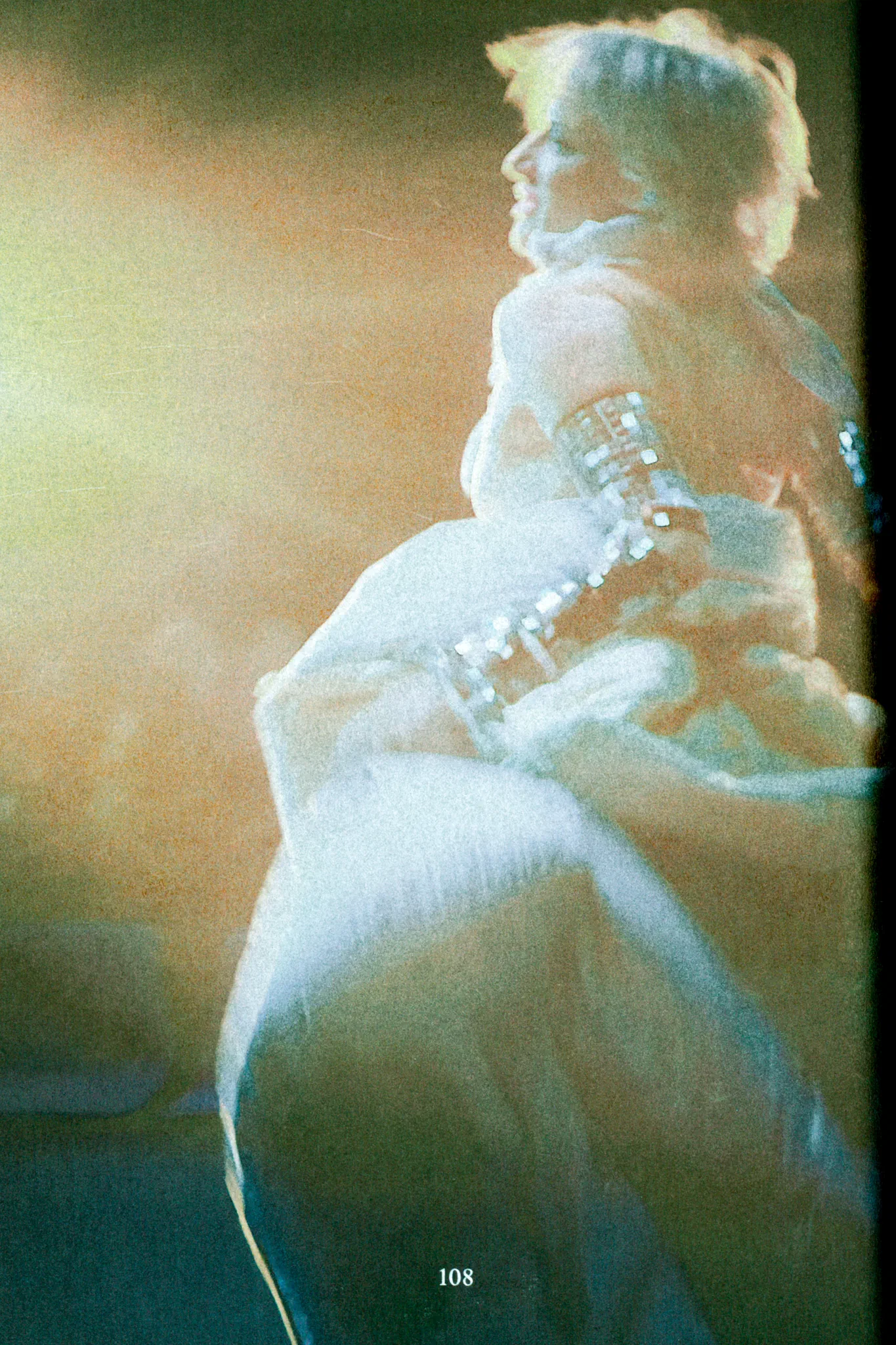
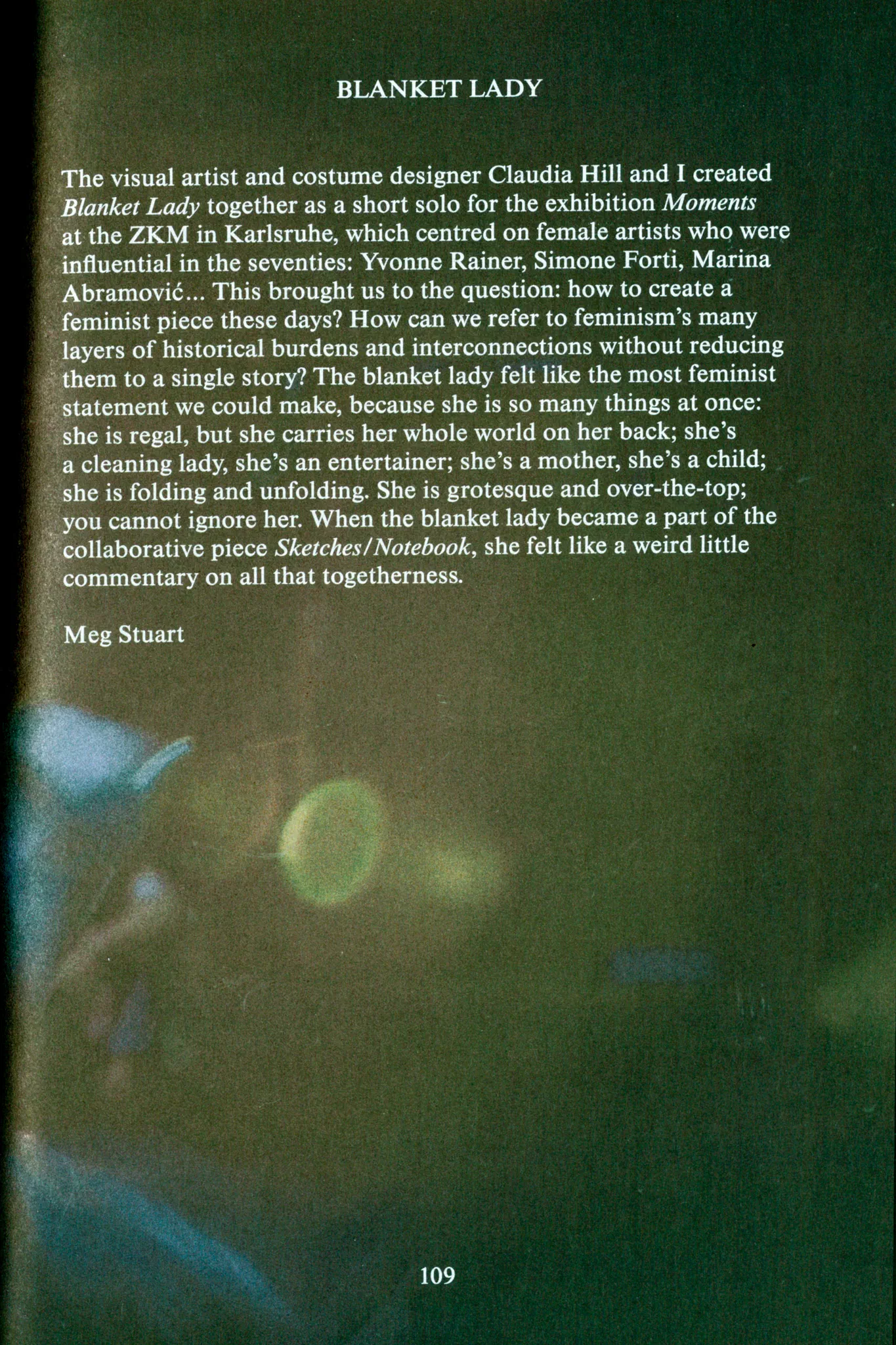
A full-page, soft-focus photograph immediately before the book's essay on the Blanket Lady costume created with Claudia Hill: a figure wrapped in pale draped fabric, caught in warm backlight, with no caption of its own. Placed where it is, it reads as a performance image of that costume.
A text page in which Meg Stuart describes creating the character Blanket Lady together with visual artist and costume designer Claudia Hill, as a short solo for the exhibition Moments at the ZKM in Karlsruhe, a show centered on influential female artists of the 1970s. Stuart calls the character deliberately contradictory: regal yet burdened, a cleaning lady and an entertainer, a mother and a child, and notes her later reappearance within the collaborative piece Sketches/Notebook.
A text page carrying the poem Lift It by Myriam Van Imschoot, written in response to the Blanket Lady character. It calls her a walking paradox who hoards secrets and gossip in her folds, caught between urban legend and vagrancy, ending with an instruction to lift her skirt and find the truth underneath.
The opening spread of an interview titled Conversation with Claudia Hill on Character Building through Costume Design, conducted by Astrid Kaminski under the heading I Was Suddenly Wearing Antlers. Hill contrasts her earlier work designing costumes for film and Broadway, where she supports an already emerging character, with Blanket Lady, for which she built a sculptural costume first and Meg Stuart then stepped into it; she cites Reinhild Hoffmann and Lynn Hershman as reference points.
The interview continues: Hill traces the costume's materials to her grandmother's household and to how women's bodies have historically been shaped by clothing, while Kaminski asks whether the layered fabric and partial nudity amount to a feminist statement about shedding old coverings. Hill describes dressing in black to mark herself as backstage, yet being pulled on stage into shifting relationships with its wearer: mother and child, caretaker and frail body, maid and mistress.
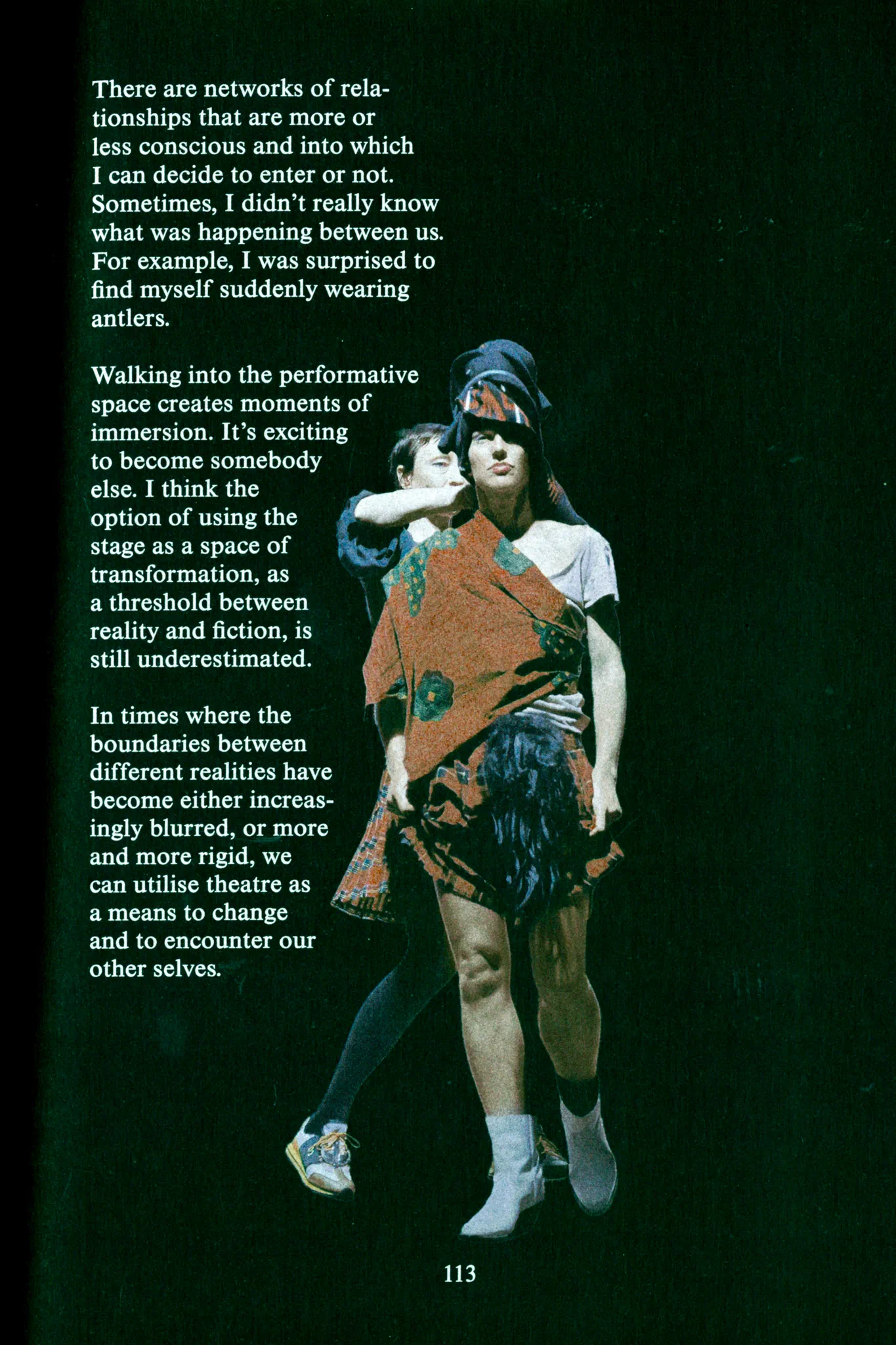
The interview closes with Hill reflecting on the unpredictability of performing alongside Meg Stuart, recalling being surprised to find herself suddenly wearing antlers, and on theater as a space for trying on other selves. Beside the text, a photograph shows a dancer in an orange floral wrap over a white top, a dark draped headpiece, and a fringed skirt, with a second figure reaching up behind her.
A text page carrying the poem Boat by Ezra Green, printed with no accompanying image. Its short, broken lines describe trust as a kind of blindness that carries the speaker gently, admitting in the end that there was never really a harbor, a lesson, or a secret to find, only the drift itself.
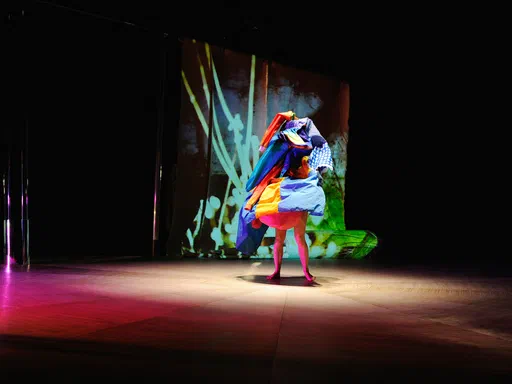
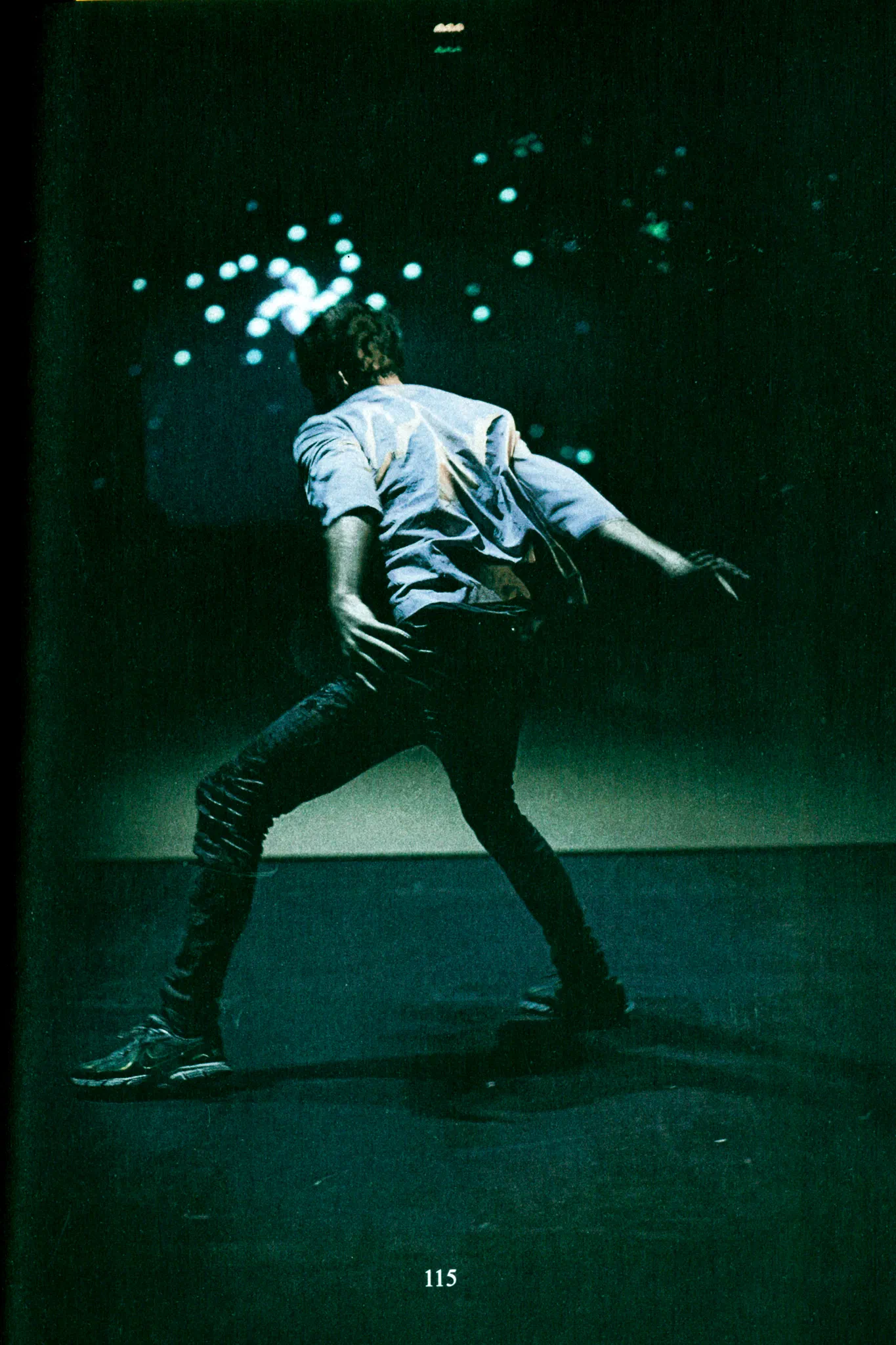
The photographic sequence resumes here with a full-page, uncaptioned stage shot, right after the interview with Claudia Hill on the Blanket Lady costume. A dancer lunges away from the camera in a pale, wrinkled shirt, silhouetted beneath a scatter of small stage lights.
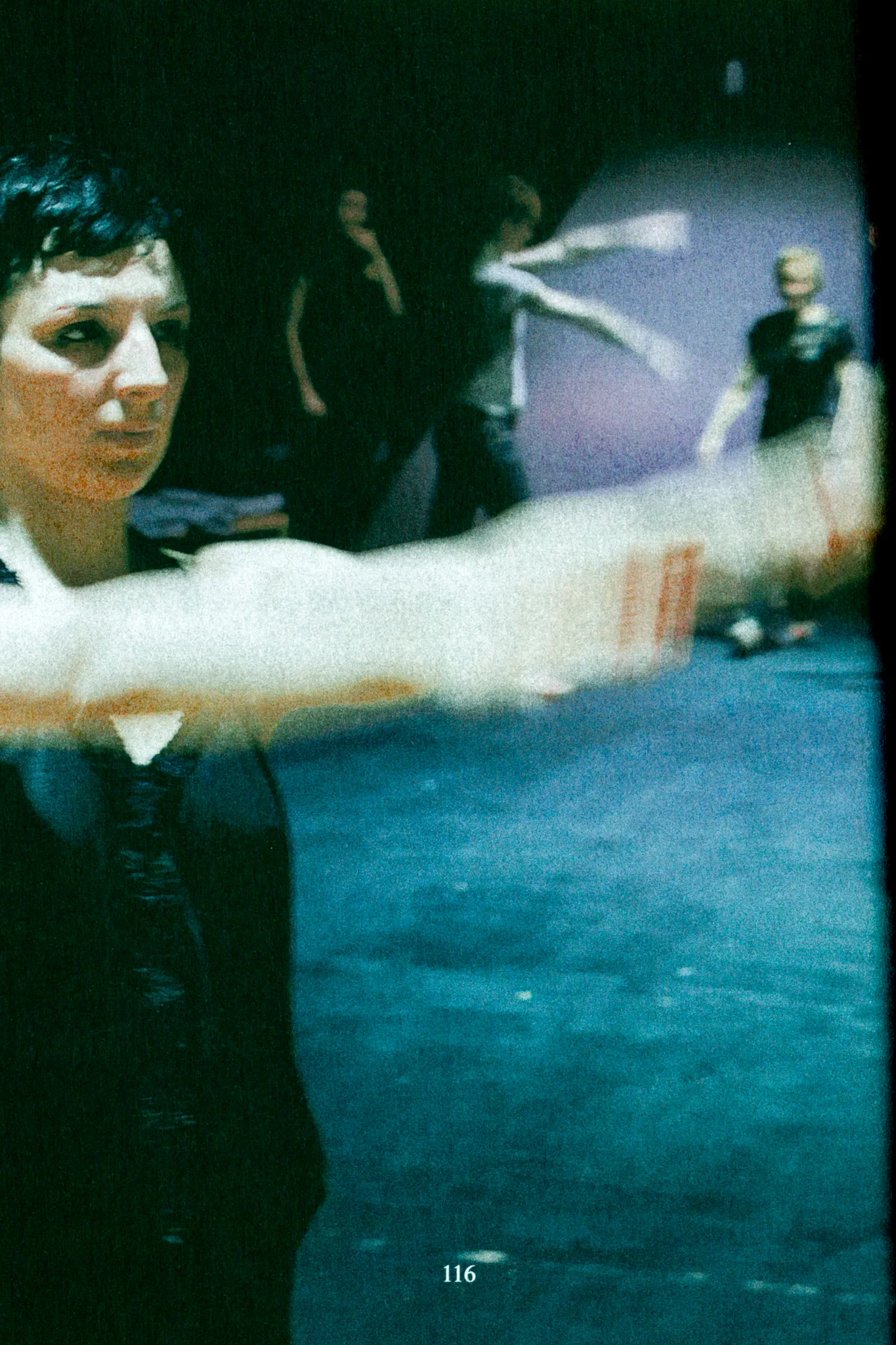
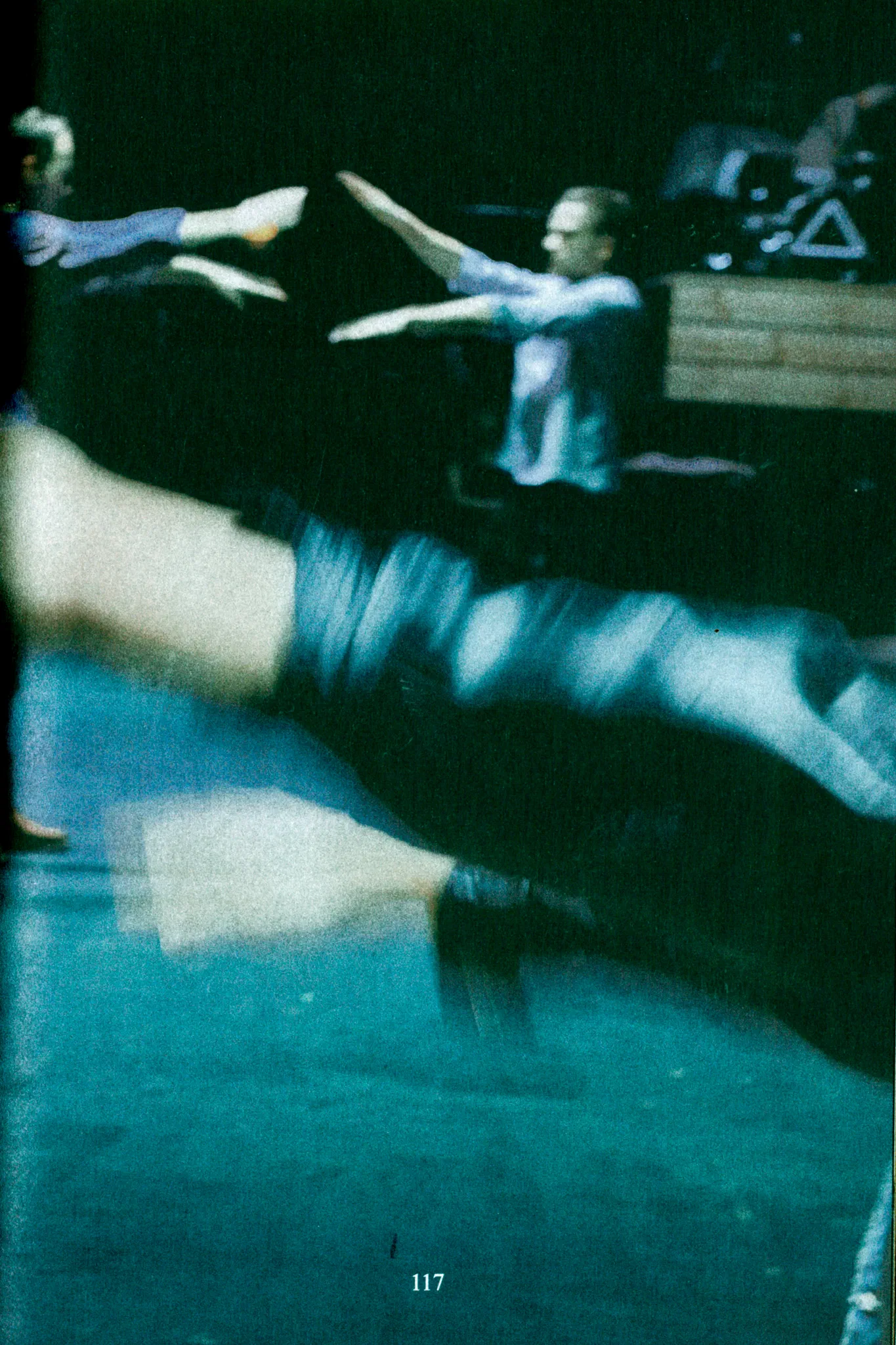
Another uncaptioned full-page photograph a few pages on, this one motion-blurred: a woman's face appears close beside her own bandage-wrapped arm as it sweeps outward, while other dancers behind her dissolve into streaks of blue light.
The final page in this excerpt, again motion-blurred and uncaptioned: several dancers' arms and legs cross the frame at odd angles under teal stage light, the picture dissolving almost entirely into pure movement and color.
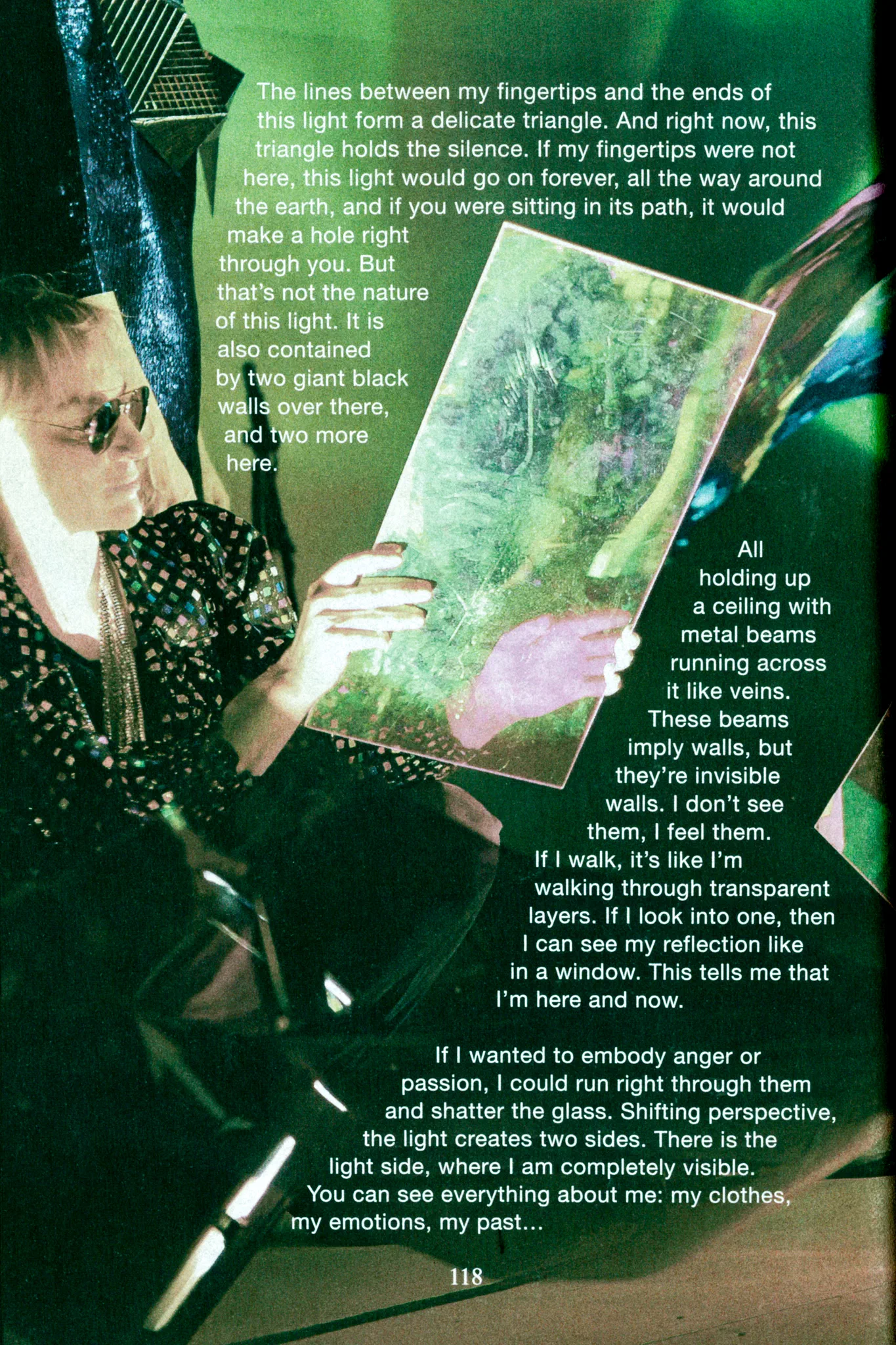
A page from the book Let's Not Get Used to This Place, carrying an excerpt of Borderland, the performance text Jorge De Hoyos wrote for Meg Stuart's Sketches/Notebook. Spoken in the first person, the passage is a meditation on light, boundaries and invisibility. It runs over a photograph of a performer in a sequined top holding up a glowing green panel.
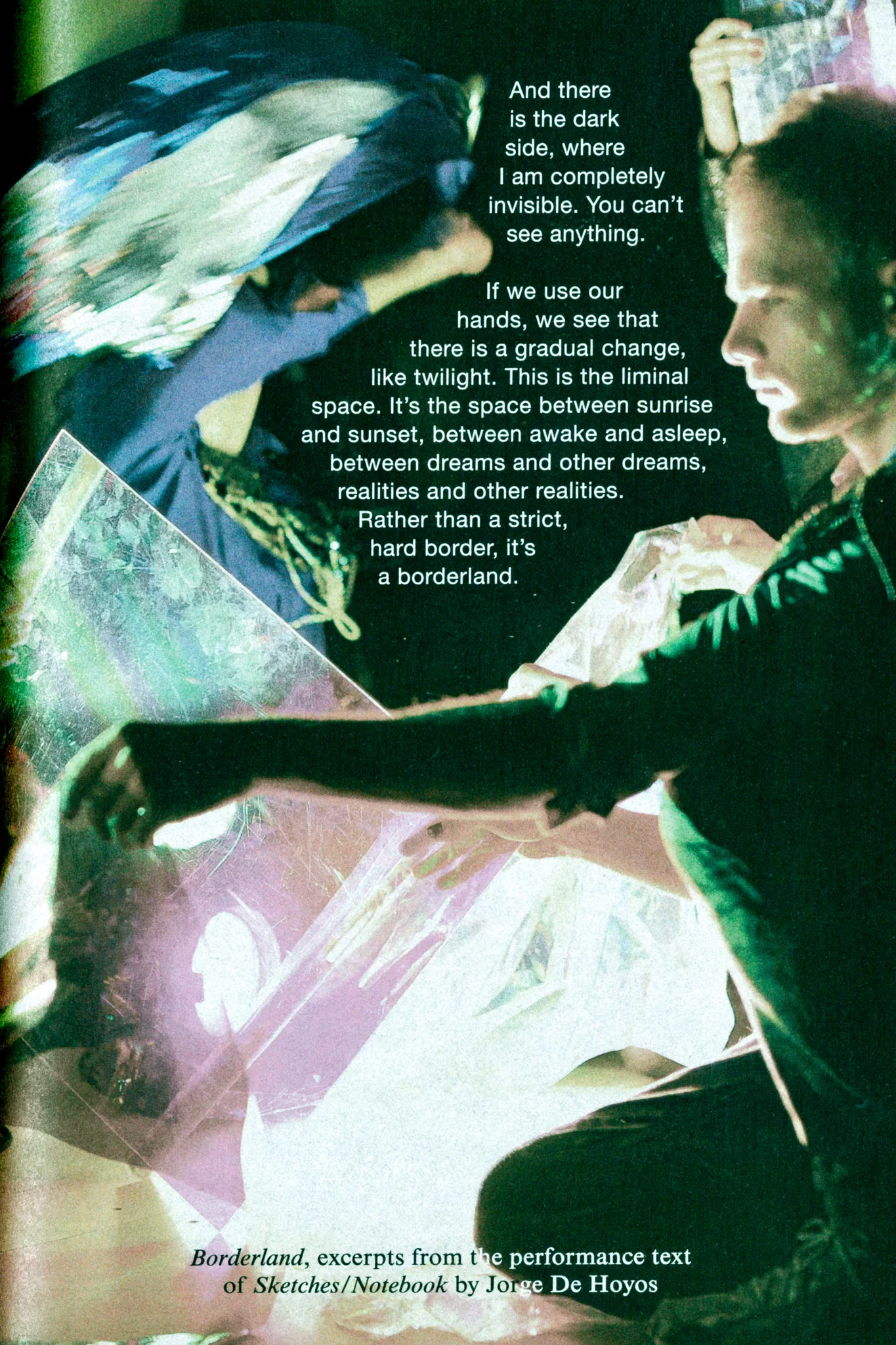
The excerpt from Borderland continues onto this page, still meditating on light and on the borderland between waking and dreaming, visibility and invisibility. A closing line credits the performance text to Jorge De Hoyos. The passage sits over a photograph of two performers, one swinging fabric overhead in a blur of motion.
An interview titled Replacing the Safety Net, a conversation about humor between critic Astrid Kaminski and choreographer Meg Stuart. Stuart discusses her own loud laugh, laughing and crying as linked states, and names the grotesque Blanket Lady alter ego she developed with costume designer Claudia Hill for Sketches/Notebook. She sets this grotesque undertone in her work apart from humor proper, which she calls a more subtle, social force.
The interview continues: Stuart separates humor, which she describes as having a healing quality, from the grotesque, which she says only deepens a wound. She names Marlene Monteiro Freitas and Dana Michel as artists who move fluidly across that line, and Kaminski asks how Stuart herself balances a wish for harmony against humor's crueler, exposing side.
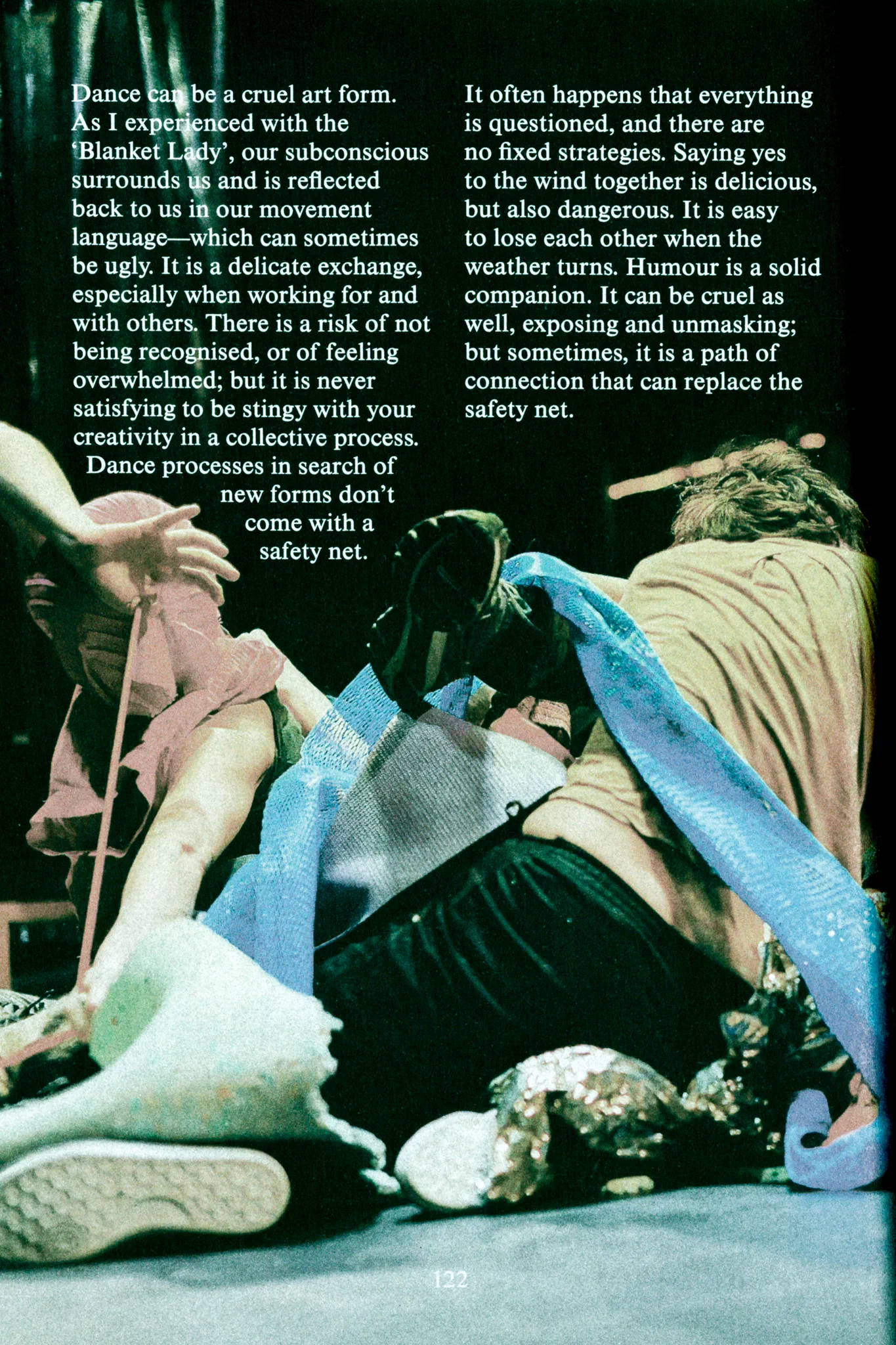
The interview closes with Stuart calling dance a cruel art form, reflecting on the risk of feeling overwhelmed or unrecognized in collective creative work, drawn from her own experience performing the Blanket Lady. It ends on the line that gives the book its title: dance processes in search of new forms don't come with a safety net. The text is printed over a photograph of dancers entangled in pale fabric and sequins on stage.
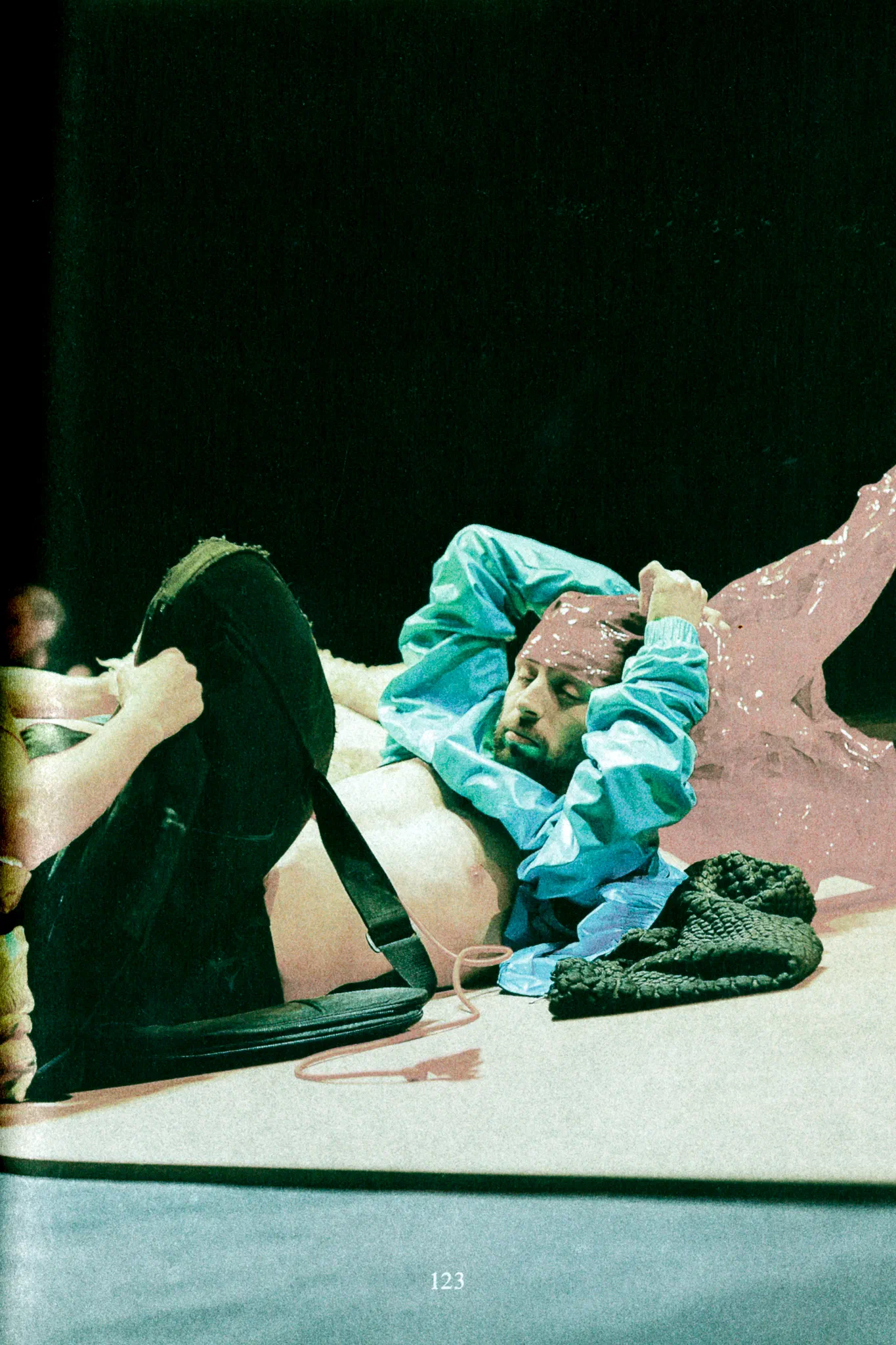
A full-page stage photograph with no accompanying text, continuing the same picture sequence as the preceding pages. It shows a performer reclining in a teal satin jacket and a pink headcloth, one of several uncaptioned production stills reproduced through this section of the book.
Another uncaptioned full-page photograph, more abstract than the one before it: a figure seen from behind, walking away, the print scratched and overlaid with a dark stripe across a peach-toned ground. It reads as a treated or degraded image rather than a straightforward documentary shot.
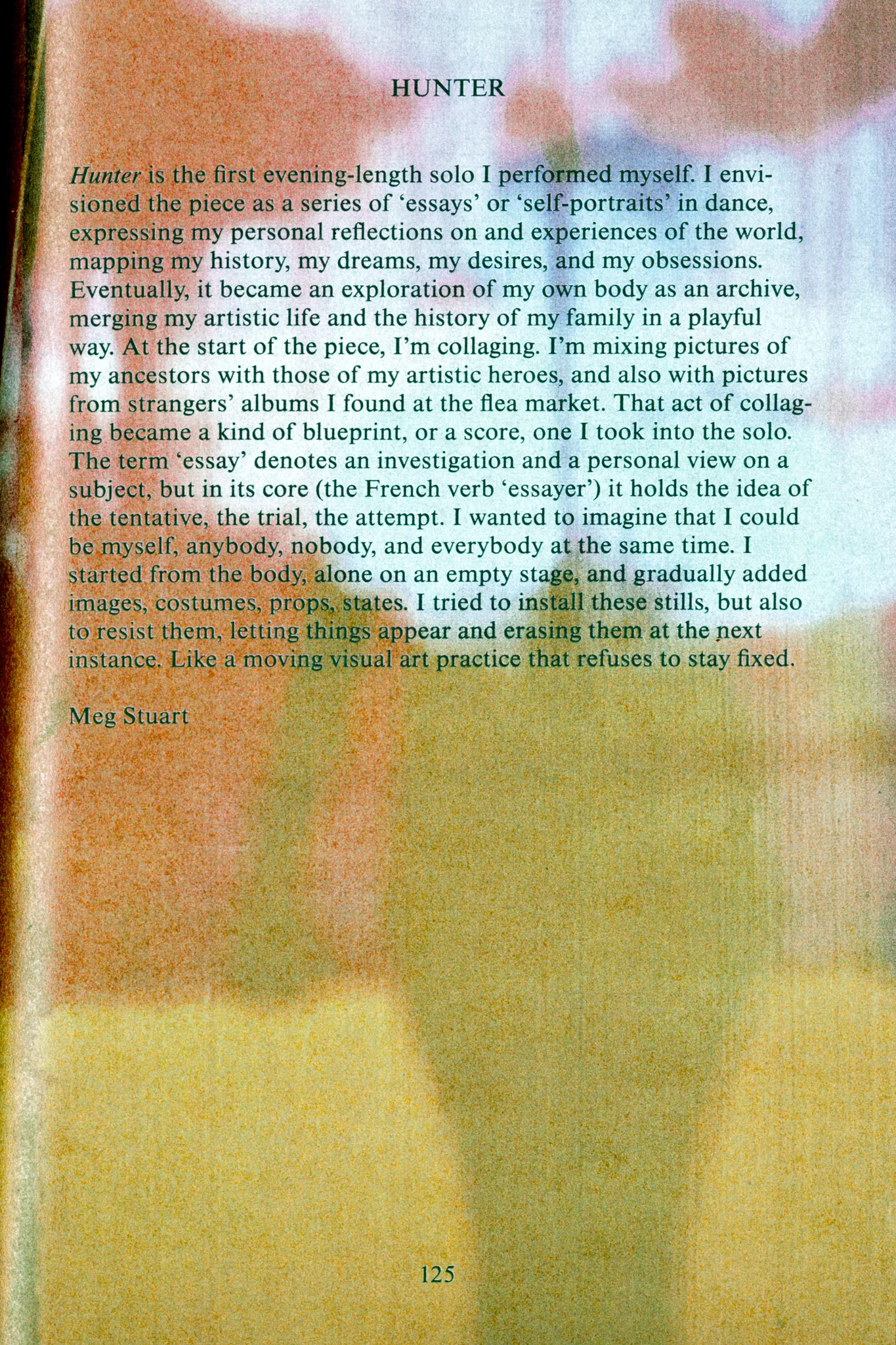
A text titled Hunter, in which Meg Stuart introduces the piece as the first evening-length solo she performed herself: a series of dance essays or self-portraits mapping her history, dreams and obsessions. She describes starting from collaged images of her ancestors, her artistic heroes and strangers found at a flea market, and signs the piece herself. It is printed over a faded, blurred photograph in orange and yellow-green tones.
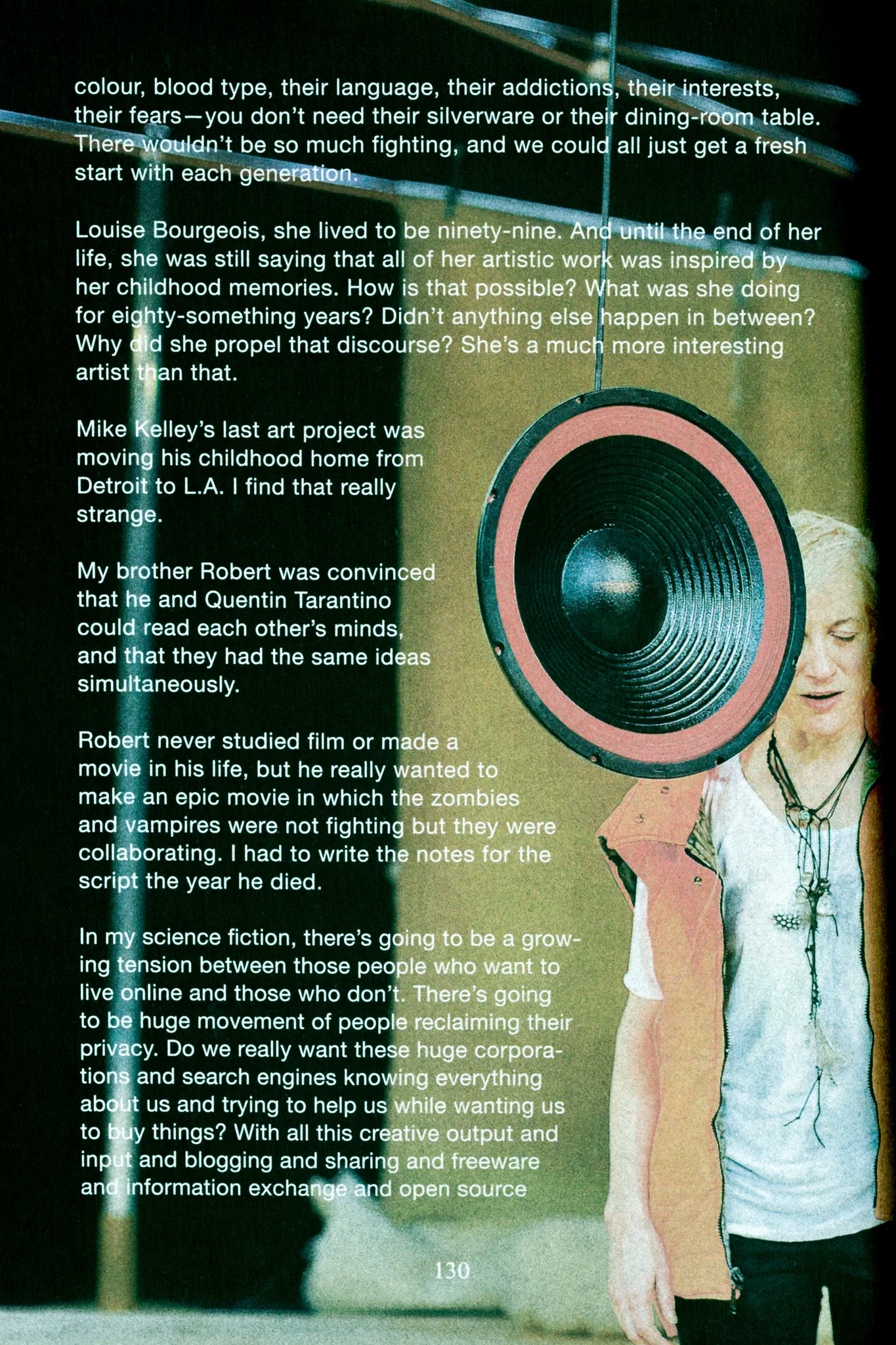
A page from It's Always in Flashes and Fragments, the performance text written for Meg Stuart's solo Hunter (2014 to 2016), presented as a run of short, disconnected musings. Here they move from a wish to inherit only memories rather than possessions, through anecdotes about Louise Bourgeois, Mike Kelley and the writer's brother, to worries about privacy online. A photograph beside the text shows a woman in a white top and coral jacket next to a large hanging speaker cone.
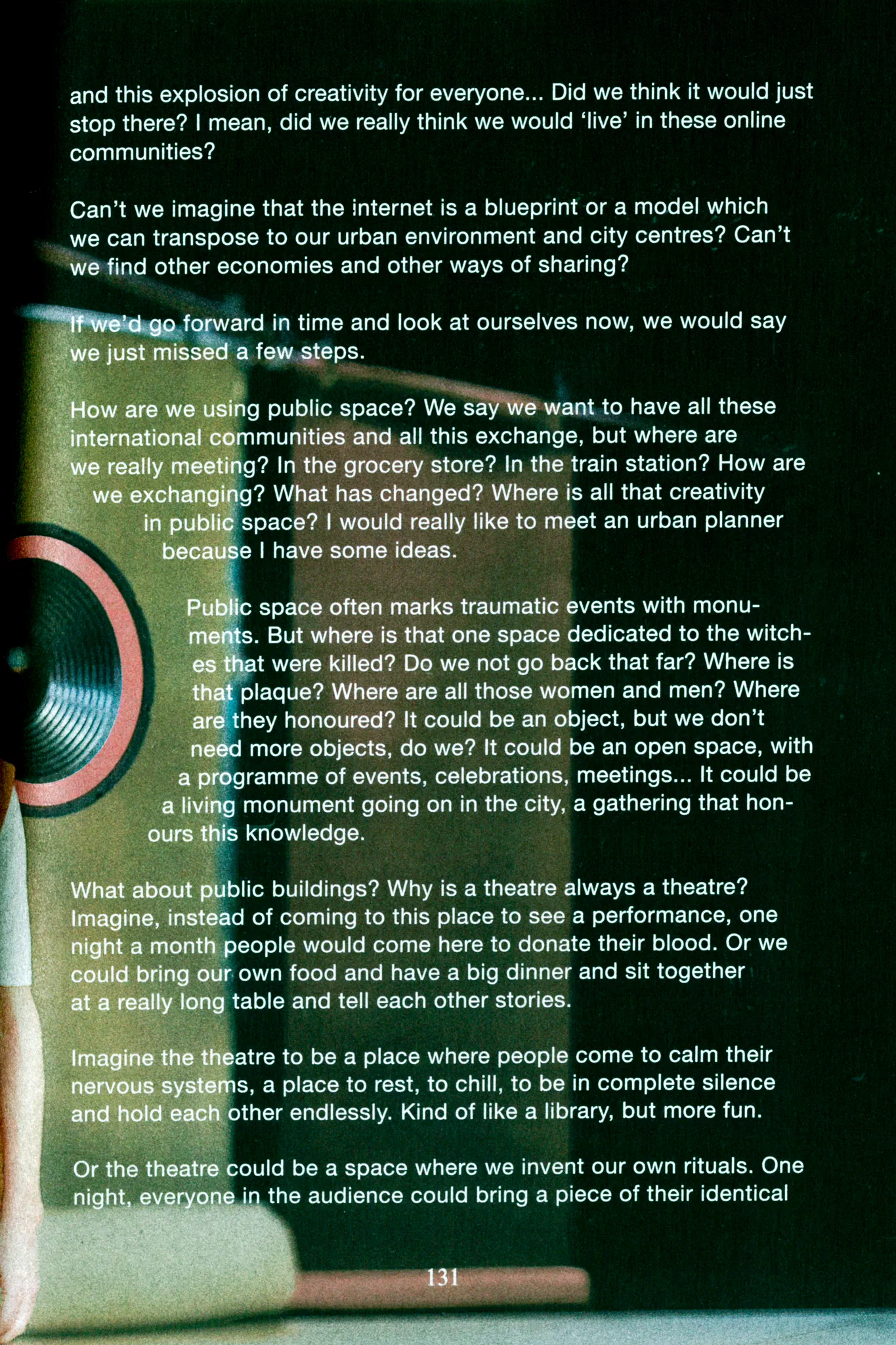
The same text continues, moving from questions about the internet as a model for public space to a call for a monument honoring the witches once killed, and on to ideas for reinventing the theater itself: a place to donate blood, share a meal, or simply rest in silence together. The hanging speaker cone from the previous page's photograph is visible again at the edge of this one.
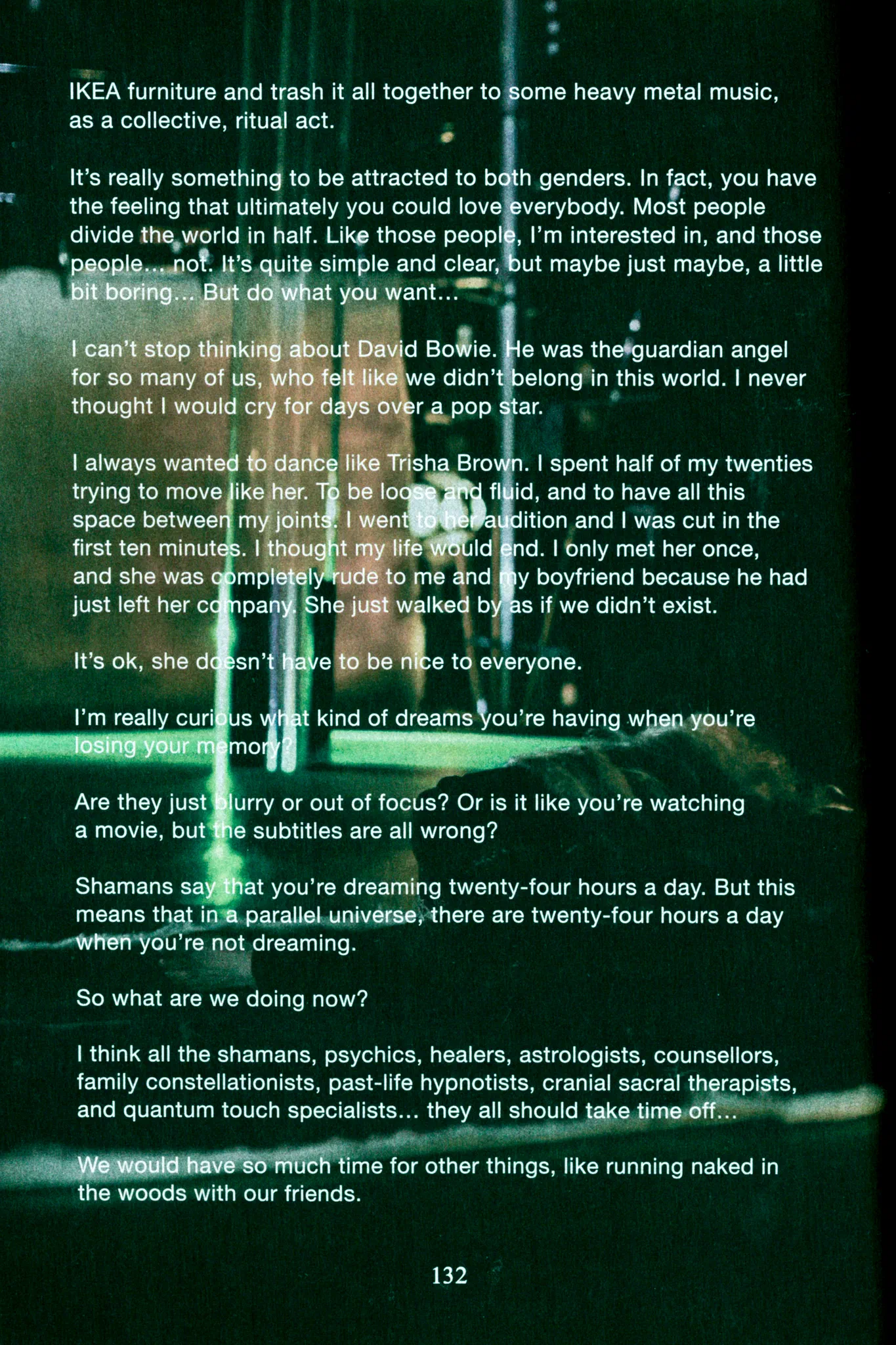
The musings continue with reflections on being drawn to both genders, grief over David Bowie's death, and a memory of being cut from a Trisha Brown audition within ten minutes. Later lines wonder what dreams look like when memory is failing, and joke that psychics, healers and astrologers should all take time off so people could run naked through the woods instead.
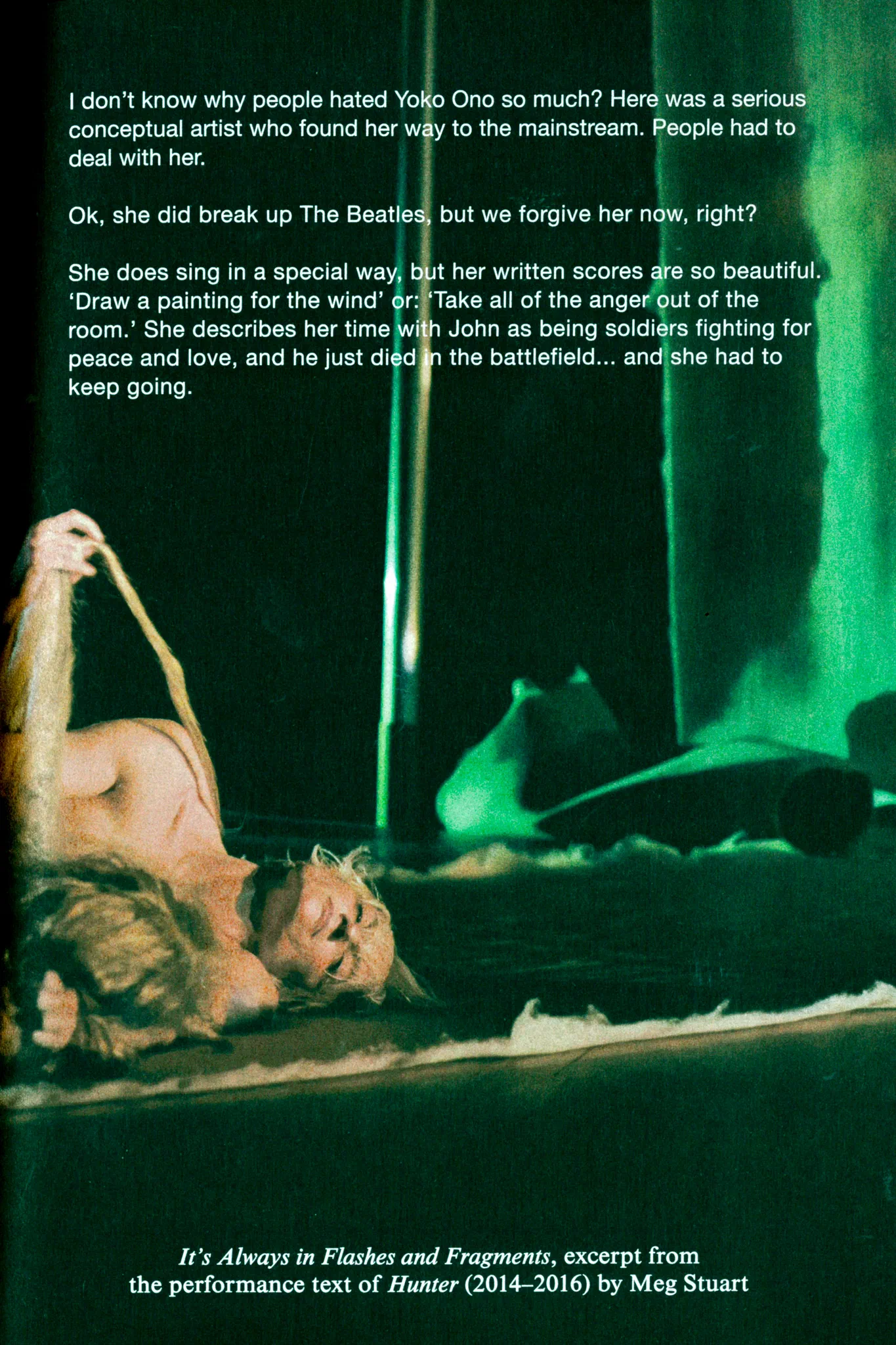
The text concludes by defending Yoko Ono as a serious conceptual artist unfairly blamed for the Beatles' breakup, recalling two lines from her written scores and her account of her years with John Lennon. A closing credit identifies the excerpt as coming from the performance text of Hunter (2014 to 2016) by Meg Stuart, set beside a photograph of a nude performer reclining under green stage light.
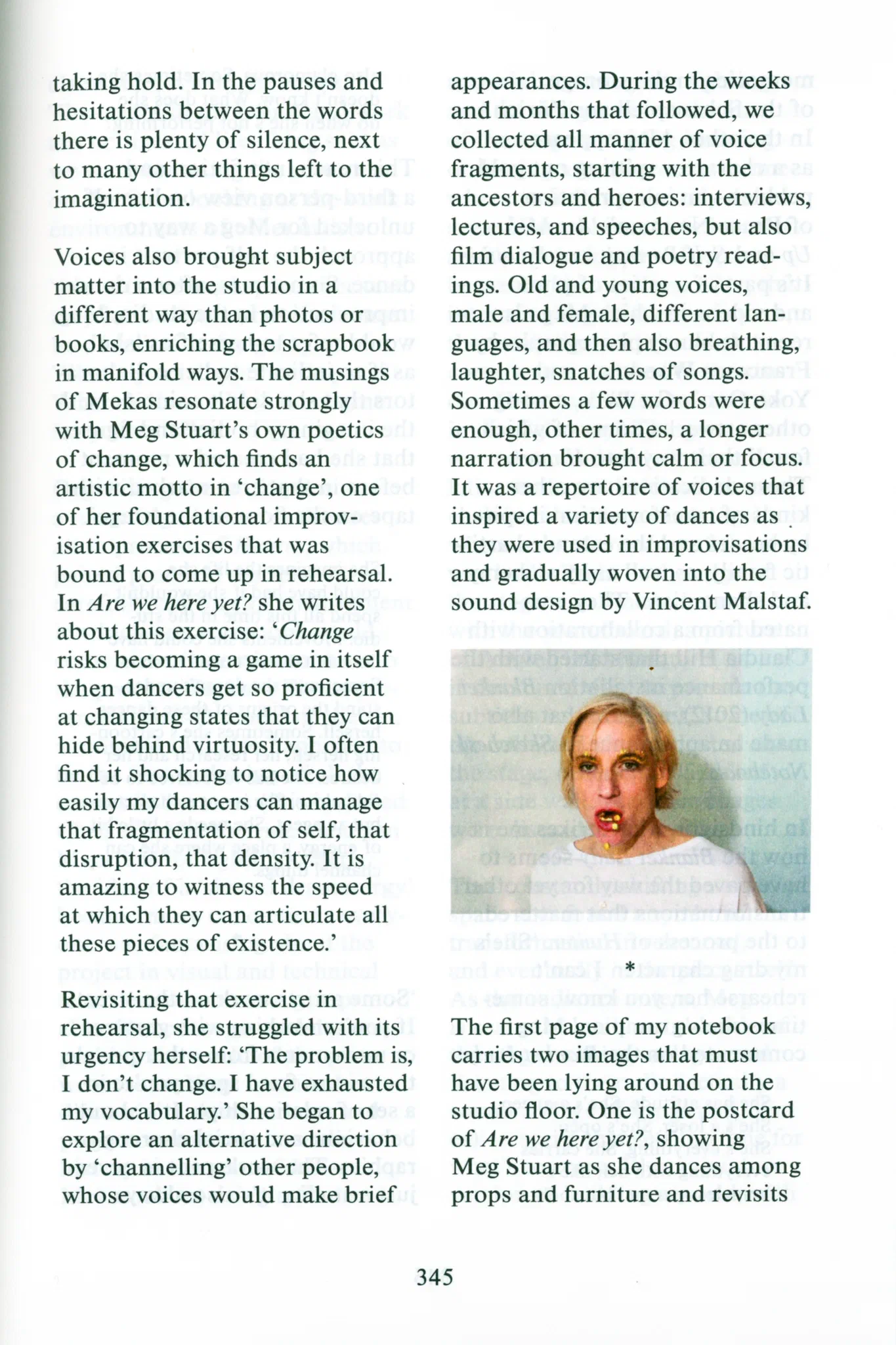
A page from an essay describing how voice recordings, gathered from interviews, lectures, film dialogue and poetry readings by artistic forebears, were woven into the sound design Vincent Malstaf built for Hunter. It quotes Stuart on the exercise of channelling other people's voices once her own vocabulary felt exhausted. An inset photograph shows a woman with small gold star decorations on her face, mouth open mid-expression.
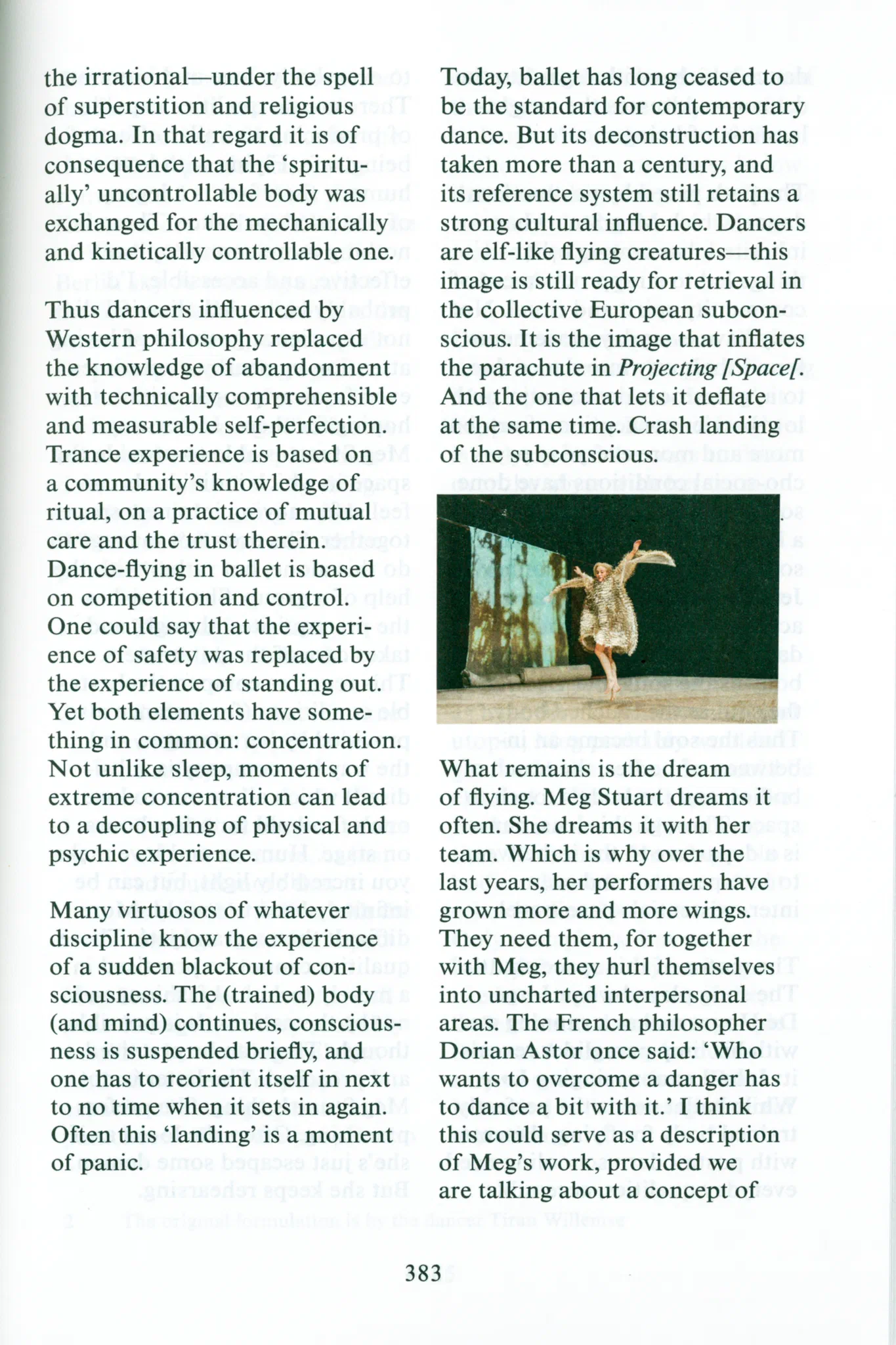
A page from an essay on ballet's lingering hold over contemporary dance, arguing that the old image of dancers as elf-like flying creatures still surfaces in Meg Stuart's work, for instance in the inflating parachute of Projecting [Space[. It notes that her performers have grown more wings over the years, and closes by likening her work to a philosopher's idea that overcoming a danger means dancing with it. A photograph shows a dancer in a feathered costume leaping past a rolled-up screen.
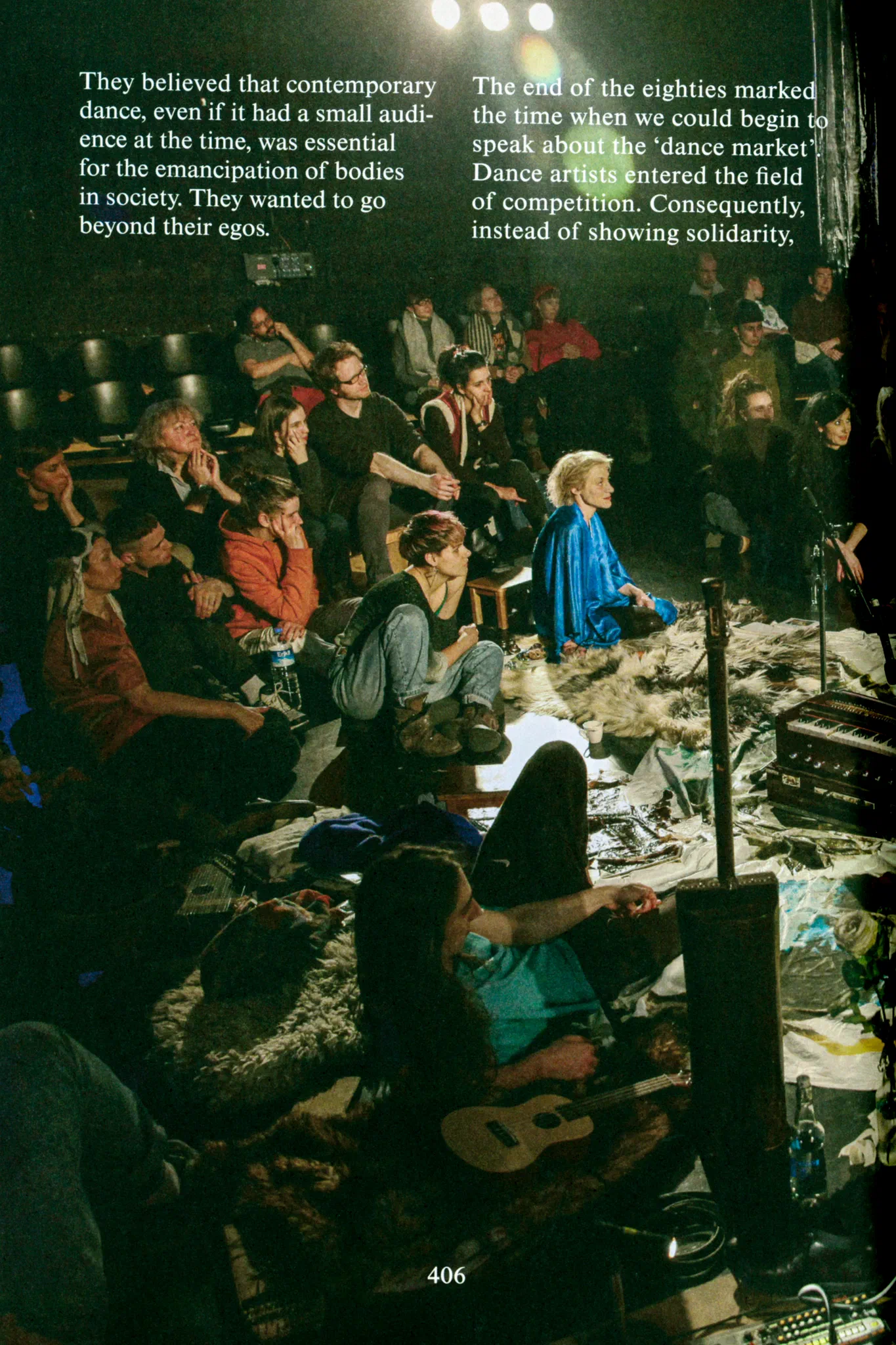
A page from what reads as a transcribed group discussion on the history of the European dance scene: how small early audiences still felt essential to the emancipation of the body, and how the end of the 1980s brought a competitive dance market that eroded solidarity among artists. The text runs over a photograph of an audience seated on furs and cushions around a performer in a blue robe.
The discussion continues, describing how mistrust and career competition dissolved the earlier sense of community, then turning to praise something called SKITe as radical for reaching beyond the French dance scene into wider international territory. The photograph shows a man in a gold sequined top addressing the same seated audience, beside a painted cloth spread across the floor.