Striking Claudia Dresses Forsythe’s Dancers
By Wiebke Fey
Frankfurt. Before the rehearsal at the Bockenheimer Depot: on the ground-level stage of the TAT, William Forsythe’s dance team is getting going and stretching its muscles. They are enjoying the break between training and the start of the rehearsal. Yesterday it had got late, a hard day’s work. The boss, too, trips across the black floor in small, elegant pirouettes and hums a few bars from the Nussknackersuite (Nutcracker Suite) while balancing a small red ball on his head.
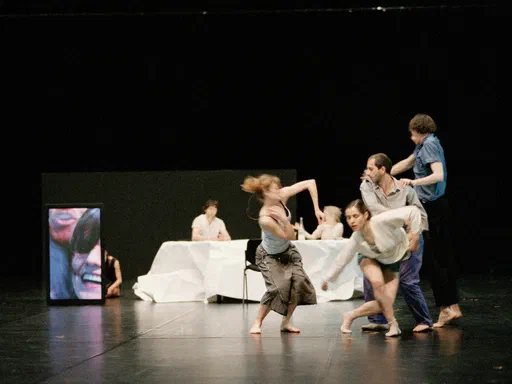
But this is not about Tchaikovsky; it is about modern music and modern ballet. What is being rehearsed here is a world premiere. Forsythe is choreographing the ballet “Decreation” by Thom Willems, the specialist in electronic music. He and Forsythe have already worked together several times. The premiere of the newest production is on 29 April. It is a coproduction of the Ballett Frankfurt with the Lincoln Center for the Performing Arts in New York.
New to the company is the costume designer Claudia Hill (34), who lived in New York for a long time and now commutes back and forth between Frankfurt and Berlin. She has found accommodation in one of the theater’s guest flats in Sachsenhausen. By background the costume designer is actually a fashion designer, and in Frankfurt she is now making her stage debut. She was born in Erlangen, but she lived in the USA for a good many years and there she not only trained as a dancer but later also worked in fashion design. That is how life goes: now she has the opportunity to combine the two. After all, she knows from her own experience exactly what a dancer likes to wear and ought to wear.
Here in Frankfurt, however, things are a little different from how they are in the field of fashion, or in the classical theater. Claudia Hill, who has also made a name for herself in Tokyo, will not be delivering perfect costumes. In any case, the word costume displeases her in this context anyway. She takes her bearings from the title of the new production. “Decreation”: the word does not actually exist, but it points towards reducing, removing. “Taking things away,” says Claudia Hill, who is dressed in jeans and a T-shirt.
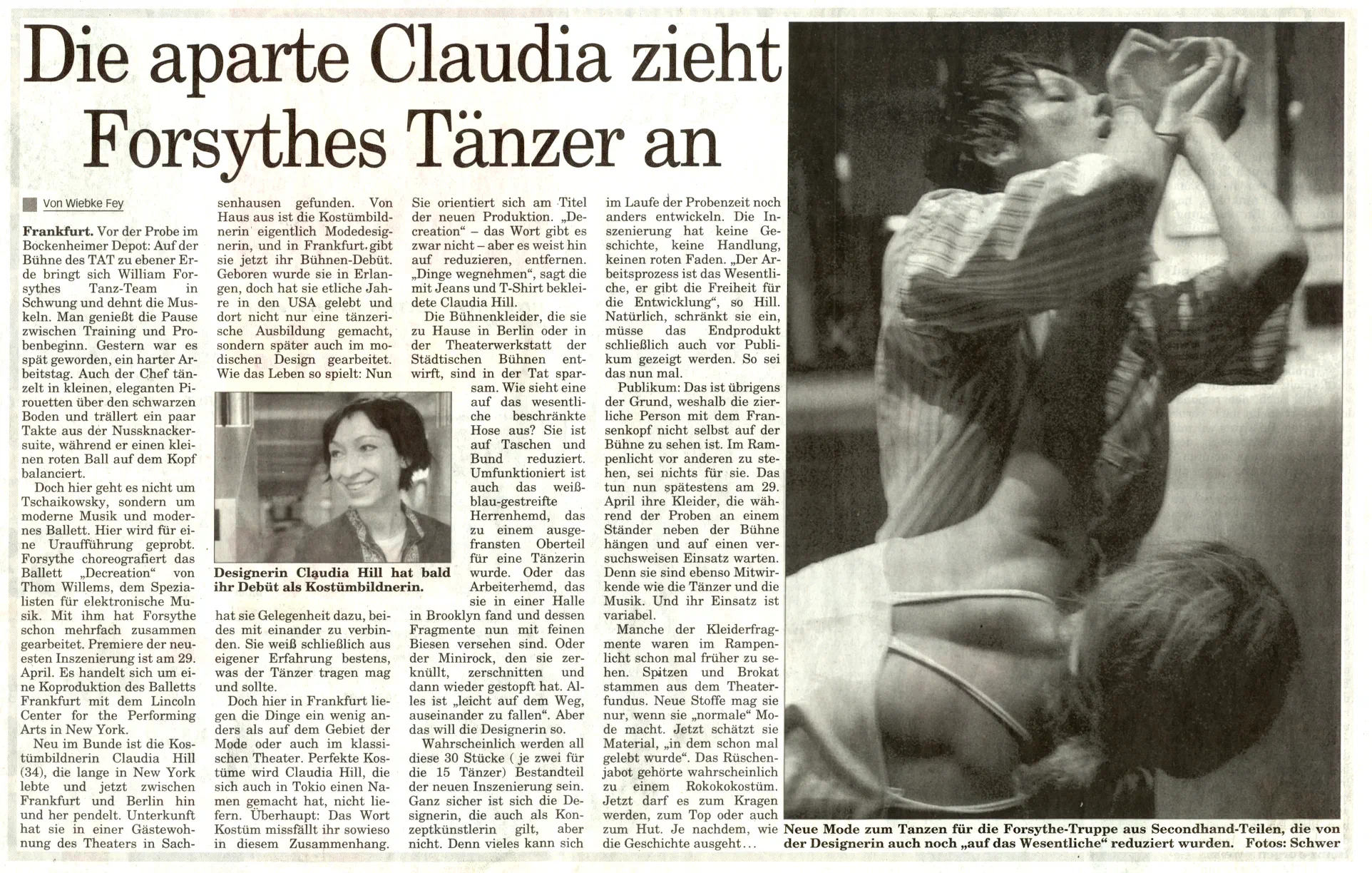
The stage clothes that she designs at home in Berlin or in the theater workshop of the Städtische Bühnen are indeed sparing. What does a pair of trousers restricted to the essentials look like? It is reduced to pockets and waistband. Put to a new use as well is the white-and-blue-striped man’s shirt that has become a frayed top for a female dancer. Or the workman’s shirt that she found in a warehouse in Brooklyn and whose fragments are now finished with fine pin tucks. Or the miniskirt that she crumpled up, cut apart and then darned together again. Everything is “slightly on the way to falling apart”. But that is how the designer wants it.
Probably all 30 of these pieces (two each for the 15 dancers) will form part of the new production. The designer, who is also regarded as a conceptual artist, is not entirely certain of that, though. Because a great deal can still develop differently in the course of the rehearsal period. The production has no story, no plot, no thread running through it. “The working process is what matters; it gives the freedom to develop,” says Hill. Of course, she qualifies, the end product does in the end have to be shown in front of an audience as well. That is just how it is.
The audience, incidentally, is the reason why the petite person with the fringed haircut is not to be seen on stage herself. Standing in the limelight in front of other people, she says, is nothing for her. That is now done, by 29 April at the latest, by her clothes, which hang on a rail beside the stage during rehearsals and wait to be tried out. For they are just as much performers as the dancers and the music are. And their use is variable.
Some of the fragments of clothing have been seen in the limelight before. Lace and brocade come from the theater’s costume store. She only likes new fabrics when she is making “normal” fashion. Now she values material “that has already been lived in”. The ruffled jabot probably belonged to a rococo costume. Now it is allowed to become a collar, a top or even a hat. Depending on how the story ends …
Translated from the original by machine.
Die aparte Claudia zieht Forsythes Tänzer an
Von Wiebke Fey
Frankfurt. Vor der Probe im Bockenheimer Depot: Auf der Bühne des TAT zu ebener Erde bringt sich William Forsythes Tanz-Team in Schwung und dehnt die Muskeln. Man genießt die Pause zwischen Training und Probenbeginn. Gestern war es spät geworden, ein harter Arbeitstag. Auch der Chef tänzelt in kleinen, eleganten Pirouetten über den schwarzen Boden und trällert ein paar Takte aus der Nussknackersuite, während er einen kleinen roten Ball auf dem Kopf balanciert.
Doch hier geht es nicht um Tschaikowsky, sondern um moderne Musik und modernes Ballett. Hier wird für eine Uraufführung geprobt. Forsythe choreografiert das Ballett „Decreation“ von Thom Willems, dem Spezialisten für elektronische Musik. Mit ihm hat Forsythe schon mehrfach zusammen gearbeitet. Premiere der neuesten Inszenierung ist am 29. April. Es handelt sich um eine Koproduktion des Balletts Frankfurt mit dem Lincoln Center for the Performing Arts in New York.
Neu im Bunde ist die Kostümbildnerin Claudia Hill (34), die lange in New York lebte und jetzt zwischen Frankfurt und Berlin hin und her pendelt. Unterkunft hat sie in einer Gästewohnung des Theaters in Sachsenhausen gefunden. Von Haus aus ist die Kostümbildnerin eigentlich Modedesignerin, und in Frankfurt gibt sie jetzt ihr Bühnen-Debüt. Geboren wurde sie in Erlangen, doch hat sie etliche Jahre in den USA gelebt und dort nicht nur eine tänzerische Ausbildung gemacht, sondern später auch im modischen Design gearbeitet. Wie das Leben so spielt: Nun hat sie Gelegenheit dazu, beides mit einander zu verbinden. Sie weiß schließlich aus eigener Erfahrung bestens, was der Tänzer tragen mag und sollte.
Doch hier in Frankfurt liegen die Dinge ein wenig anders als auf dem Gebiet der Mode oder auch im klassischen Theater. Perfekte Kostüme wird Claudia Hill, die sich auch in Tokioeinen Namen gemacht hat, nicht liefern. Überhaupt: Das Wort Kostüm missfällt ihr sowieso in diesem Zusammenhang. Sie orientiert sich am Titel der neuen Produktion. „Decreation“ – das Wort gibt es zwar nicht – aber es weist hin auf reduzieren, entfernen. „Dinge wegnehmen“, sagt die mit Jeans und T-Shirt bekleidete Claudia Hill.
Die Bühnenkleider, die sie zu Hause in Berlin oder in der Theaterwerkstatt der Städtischen Bühnen entwirft, sind in der Tat sparsam. Wie sieht eine auf das wesentliche beschränkte Hose aus? Sie ist auf Taschen und Bund reduziert. Umfunktioniert ist auch das weiß-blau-gestreifte Herrenhemd, das zu einem ausgefransten Oberteil für eine Tänzerin wurde. Oder das Arbeiterhemd, das sie in einer Halle in Brooklyn fand und dessen Fragmente nun mit feinen Biesen versehen sind. Oder der Minirock, den sie zerknüllt, zerschnitten und dann wieder gestopft hat. Alles ist „leicht auf dem Weg, auseinander zu fallen“. Aber das will die Designerin so.
Wahrscheinlich werden all diese 30 Stücke (je zwei für die 15 Tänzer) Bestandteil der neuen Inszenierung sein. Ganz sicher ist sich die Designerin, die auch als Konzeptkünstlerin gilt, aber nicht. Denn vieles kann sich im Laufe der Probenzeit noch anders entwickeln. Die Inszenierung hat keine Geschichte, keine Handlung, keinen roten Faden. „Der Arbeitsprozess ist das Wesentliche, er gibt die Freiheit für die Entwicklung“, so Hill. Natürlich, schränkt sie ein, müsse das Endprodukt schließlich auch vor Publikum gezeigt werden. So sei das nun mal.
Publikum: Das ist übrigens der Grund, weshalb die zierliche Person mit dem Fransenkopf nicht selbst auf der Bühne zu sehen ist. Im Rampenlicht vor anderen zu stehen, sei nichts für sie. Das tun nun spätestens am 29. April ihre Kleider, die während der Proben an einem Ständer neben der Bühne hängen und auf einen versuchsweisen Einsatz warten. Denn sie sind ebenso Mitwirkende wie die Tänzer und die Musik. Und ihr Einsatz ist variabel.
Manche der Kleiderfragmente waren im Rampenlicht schon mal früher zu sehen. Spitzen und Brokat stammen aus dem Theaterfundus. Neue Stoffe mag sie nur, wenn sie „normale“ Mode macht. Jetzt schätzt sie Material, „in dem schon mal gelebt wurde“. Das Rüschenjabot gehörte wahrscheinlich zu einem Rokokokostüm. Jetzt darf es zum Kragen werden, zum Top oder auch zum Hut. Je nachdem, wie die Geschichte ausgeht …