Logo of Frankfurter Rundschau

April 25, 2003 issue

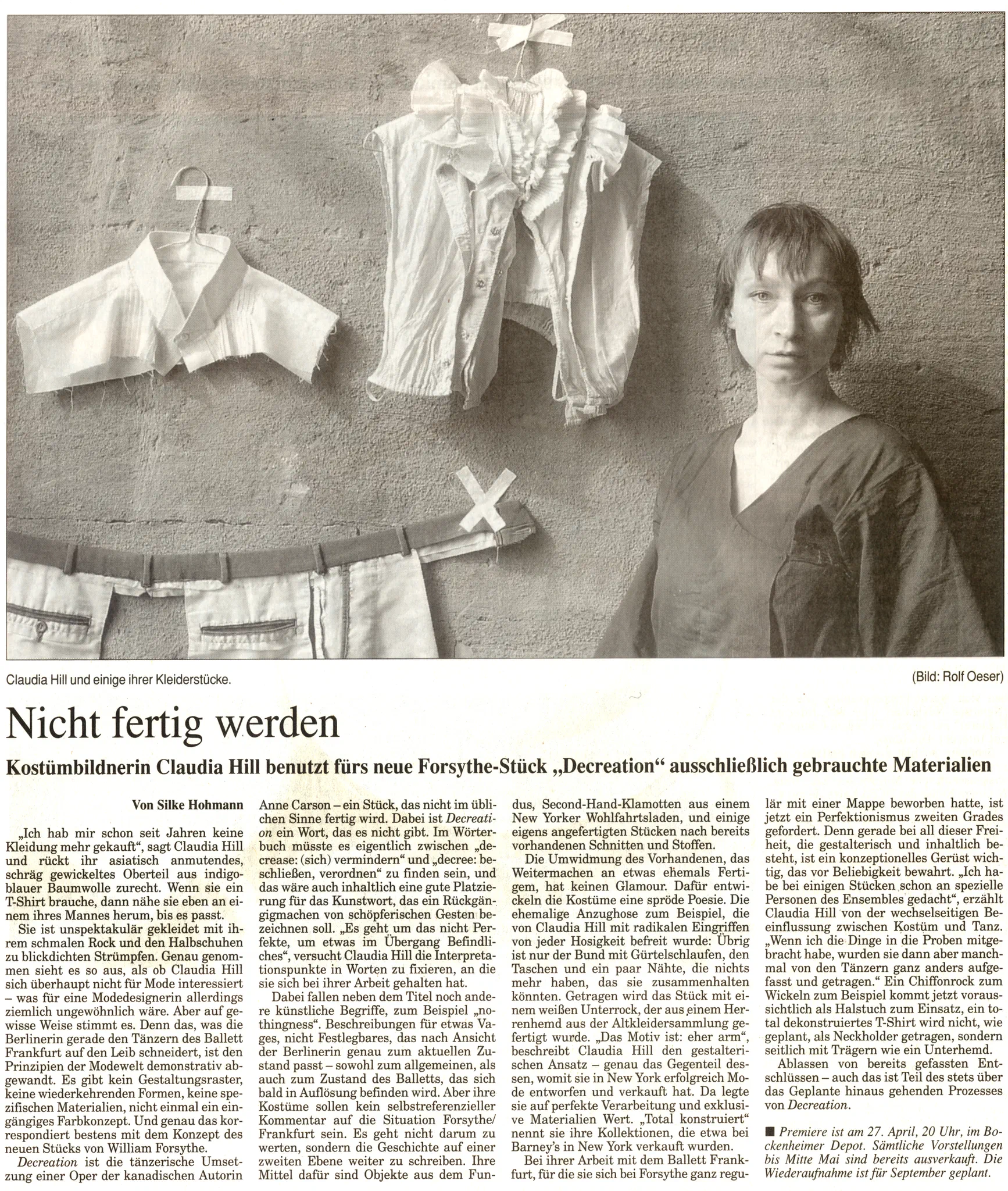
Frankfurter Rundschau, 25 April 2003, clipping: German article on Claudia Hill's Decreation costumes made of used materials, a photo of deconstructed garments taped to a wall beside her portrait

Claudia Hill and some of her pieces of clothing. (Picture: Rolf Oeser)

Never Finished

Costume designer Claudia Hill uses exclusively second-hand materials for the new Forsythe piece “Decreation”

By Silke Hohmann

“I haven’t bought myself any clothes for years,” says Claudia Hill, adjusting her Asian-looking top of indigo-blue cotton, wrapped on the diagonal. If she needs a T-shirt, she says, she simply sews away at one of her husband’s until it fits.

She is dressed unspectacularly, in her narrow skirt and flat shoes with opaque stockings. Strictly speaking, it looks as though Claudia Hill is not interested in fashion at all, which for a fashion designer would be rather unusual. But in a certain way it is true. Because what the Berlin designer is currently tailoring for the dancers of the Ballett Frankfurt turns away demonstratively from the principles of the fashion world. There is no design grid, no recurring forms, no specific materials, not even a catchy color concept. And that is exactly what corresponds best to the concept of William Forsythe’s new piece.

Decreation is the realisation in dance of an opera by the Canadian writer Anne Carson, a piece that is not finished in the usual sense. And Decreation is a word that does not exist. In the dictionary it would actually have to be found between “decrease: to diminish” and “decree: to resolve, to ordain”, and in terms of content that would be a good place for the invented word too, which is meant to denote an undoing of creative gestures. “It is about what is not perfect, about something in transition,” says Claudia Hill, trying to fix in words the points of interpretation she has held to in her work.

Alongside the title, other artificial terms come up as well, for example “nothingness”. Descriptions for something vague, something that cannot be pinned down, which in the Berlin designer’s view fits the current condition exactly: the general condition as much as the condition of the ballet company, which will soon be in dissolution. But her costumes are not meant to be a self-referential commentary on the Forsythe/Frankfurt situation. It is not a matter of passing judgment, but of writing the story onward on a second level. Her means for that are objects from the costume store, second-hand clothes from a New York charity shop, and a few pieces made specially, following patterns and fabrics that already exist.

The rededication of what is already there, the carrying on at something once finished, has no glamour. In return the costumes develop a brittle poetry. The former suit trousers, for example, which Claudia Hill freed from all trouser-ness by radical interventions: all that is left is the waistband with belt loops, the pockets and a few seams that no longer have anything they could hold together. The piece is worn with a white underskirt made from a man’s shirt from a used-clothing collection. “The motif is: rather poor,” is how Claudia Hill describes the design approach, the exact opposite of the one with which she successfully designed and sold fashion in New York. There she set store by perfect workmanship and exclusive materials. “Totally constructed” is what she calls her collections, which were sold at Barney’s in New York, among other places.

In her work with the Ballett Frankfurt, for which she had applied to Forsythe in the perfectly regular way, with a portfolio, a perfectionism of the second degree is now required. Precisely with all this freedom, which exists in design and in content, a conceptual framework is important, one that guards against arbitrariness. “With some of the pieces I did think of particular people in the ensemble,” Claudia Hill says of the mutual influence between costume and dance. “But when I brought the things into the rehearsals, they were sometimes taken up and worn by the dancers in a completely different way.” A chiffon wrap skirt, for example, now looks likely to be used as a neck scarf; a totally deconstructed T-shirt is not worn as a halter neck, as planned, but at the side with straps, like an undershirt.

Letting go of decisions already taken: that too is part of the process of Decreation, which always goes beyond what was planned.

▪ The premiere is on 27 April at 8 p.m. at the Bockenheimer Depot. All performances up to the middle of May are already sold out. The revival is planned for September.

Translated from the original by machine.

Claudia Hill und einige ihrer Kleiderstücke. (Bild: Rolf Oeser)

Nicht fertig werden

Kostümbildnerin Claudia Hill benutzt fürs neue Forsythe-Stück „Decreation” ausschließlich gebrauchte Materialien

Von Silke Hohmann

„Ich hab mir schon seit Jahren keine Kleidung mehr gekauft”, sagt Claudia Hill und rückt ihr asiatisch anmutendes, schräg gewickeltes Oberteil aus indigoblauer Baumwolle zurecht. Wenn sie ein T-Shirt brauche, dann nähe sie eben an einem ihres Mannes herum, bis es passt.

Sie ist unspektakulär gekleidet mit ihrem schmalen Rock und den Halbschuhen zu blickdichten Strümpfen. Genau genommen sieht es so aus, als ob Claudia Hill sich überhaupt nicht für Mode interessiert – was für eine Modedesignerin allerdings ziemlich ungewöhnlich wäre. Aber auf gewisse Weise stimmt es. Denn das, was die Berlinerin gerade den Tänzern des Ballett Frankfurt auf den Leib schneidert, ist den Prinzipien der Modewelt demonstrativ abgewandt. Es gibt kein Gestaltungsraster, keine wiederkehrenden Formen, keine spezifischen Materialien, nicht einmal ein eingängiges Farbkonzept. Und genau das korrespondiert bestens mit dem Konzept des neuen Stücks von William Forsythe.

Decreation ist die tänzerische Umsetzung einer Oper der kanadischen Autorin Anne Carson – ein Stück, das nicht im üblichen Sinne fertig wird. Dabei ist Decreation ein Wort, das es nicht gibt. Im Wörterbuch müsste es eigentlich zwischen „decrease: (sich) vermindern” und „decree: beschließen, verordnen” zu finden sein, und das wäre auch inhaltlich eine gute Platzierung für das Kunstwort, das ein Rückgängigmachen von schöpferischen Gesten bezeichnen soll. „Es geht um das nicht Perfekte, um etwas im Übergang Befindliches”, versucht Claudia Hill die Interpretationspunkte in Worten zu fixieren, an die sie sich bei ihrer Arbeit gehalten hat.

Dabei fallen neben dem Titel noch andere künstliche Begriffe, zum Beispiel „nothingness”. Beschreibungen für etwas Vages, nicht Festlegbares, das nach Ansicht der Berlinerin genau zum aktuellen Zustand passt – sowohl zum allgemeinen, als auch zum Zustand des Balletts, das sich bald in Auflösung befinden wird. Aber ihre Kostüme sollen kein selbstreferenzieller Kommentar auf die Situation Forsythe/ Frankfurt sein. Es geht nicht darum zu werten, sondern die Geschichte auf einer zweiten Ebene weiter zu schreiben. Ihre Mittel dafür sind Objekte aus dem Fundus, Second-Hand-Klamotten aus einem New Yorker Wohlfahrtsladen, und einige eigens angefertigten Stücken nach bereits vorhandenen Schnitten und Stoffen.

Die Umwidmung des Vorhandenen, das Weitermachen an etwas ehemals Fertigem, hat keinen Glamour. Dafür entwickeln die Kostüme eine spröde Poesie. Die ehemalige Anzughose zum Beispiel, die von Claudia Hill mit radikalen Eingriffen von jeder Hosigkeit befreit wurde: Übrig ist nur der Bund mit Gürtelschlaufen, den Taschen und ein paar Nähte, die nichts mehr haben, das sie zusammenhalten könnten. Getragen wird das Stück mit einem weißen Unterrock, der aus einem Herrenhemd aus der Altkleidersammlung gefertigt wurde. „Das Motiv ist: eher arm”, beschreibt Claudia Hill den gestalterischen Ansatz – genau das Gegenteil dessen, womit sie in New York erfolgreich Mode entworfen und verkauft hat. Da legte sie auf perfekte Verarbeitung und exklusive Materialien Wert. „Total konstruiert” nennt sie ihre Kollektionen, die etwa bei Barney’s in New York verkauft wurden.

Bei ihrer Arbeit mit dem Ballett Frankfurt, für die sie sich bei Forsythe ganz regulär mit einer Mappe beworben hatte, ist jetzt ein Perfektionismus zweiten Grades gefordert. Denn gerade bei all dieser Freiheit, die gestalterisch und inhaltlich besteht, ist ein konzeptionelles Gerüst wichtig, das vor Beliebigkeit bewahrt. „Ich habe bei einigen Stücken schon an spezielle Personen des Ensembles gedacht”, erzählt Claudia Hill von der wechselseitigen Beeinflussung zwischen Kostüm und Tanz. „Wenn ich die Dinge in die Proben mitgebracht habe, wurden sie dann aber manchmal von den Tänzern ganz anders aufgefasst und getragen. ” Ein Chiffonrock zum Wickeln zum Beispiel kommt jetzt voraussichtlich als Halstuch zum Einsatz, ein total dekonstruiertes T-Shirt wird nicht, wie geplant, als Neckholder getragen, sondern seitlich mit Trägern wie ein Unterhemd.

Ablassen von bereits gefassten Entschlüssen - auch das ist Teil des stets über das Geplante hinaus gehenden Prozesses von Decreation.

▪ Premiere ist am 27. April, 20 Uhr, im Bockenheimer Depot. Sämtliche Vorstellungen bis Mitte Mai sind bereits ausverkauft. Die Wiederaufnahme ist für September geplant.